AMIC Board Chair gets Alumni Award

AMIC Board Chair gets Alumni Award

AMIC Board Chair gets Alumni Award

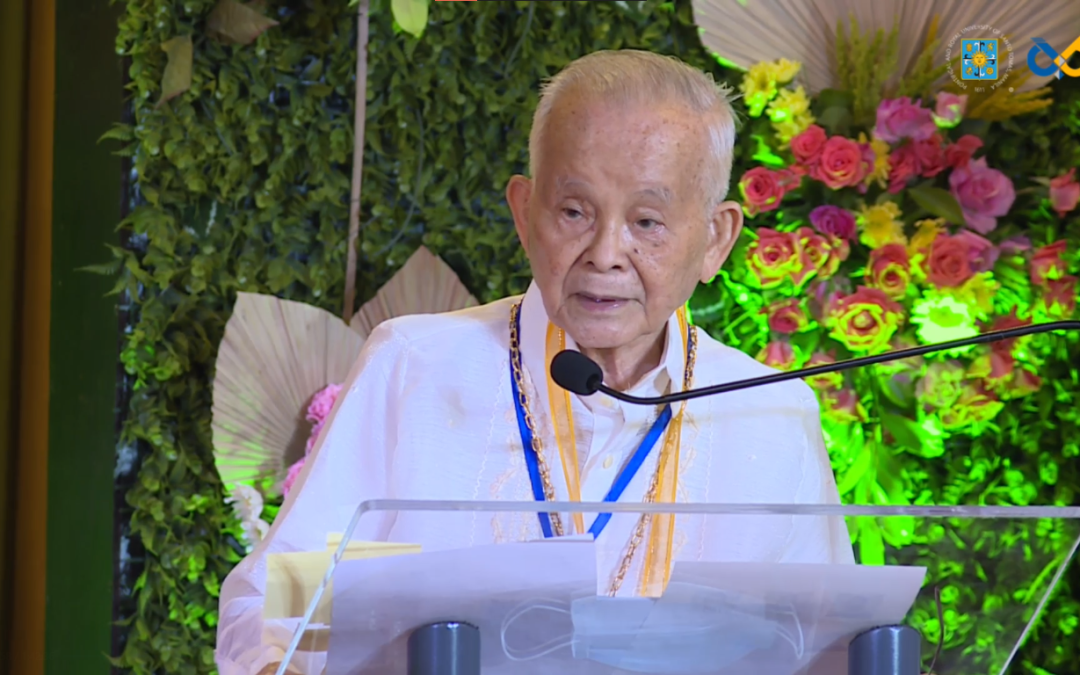
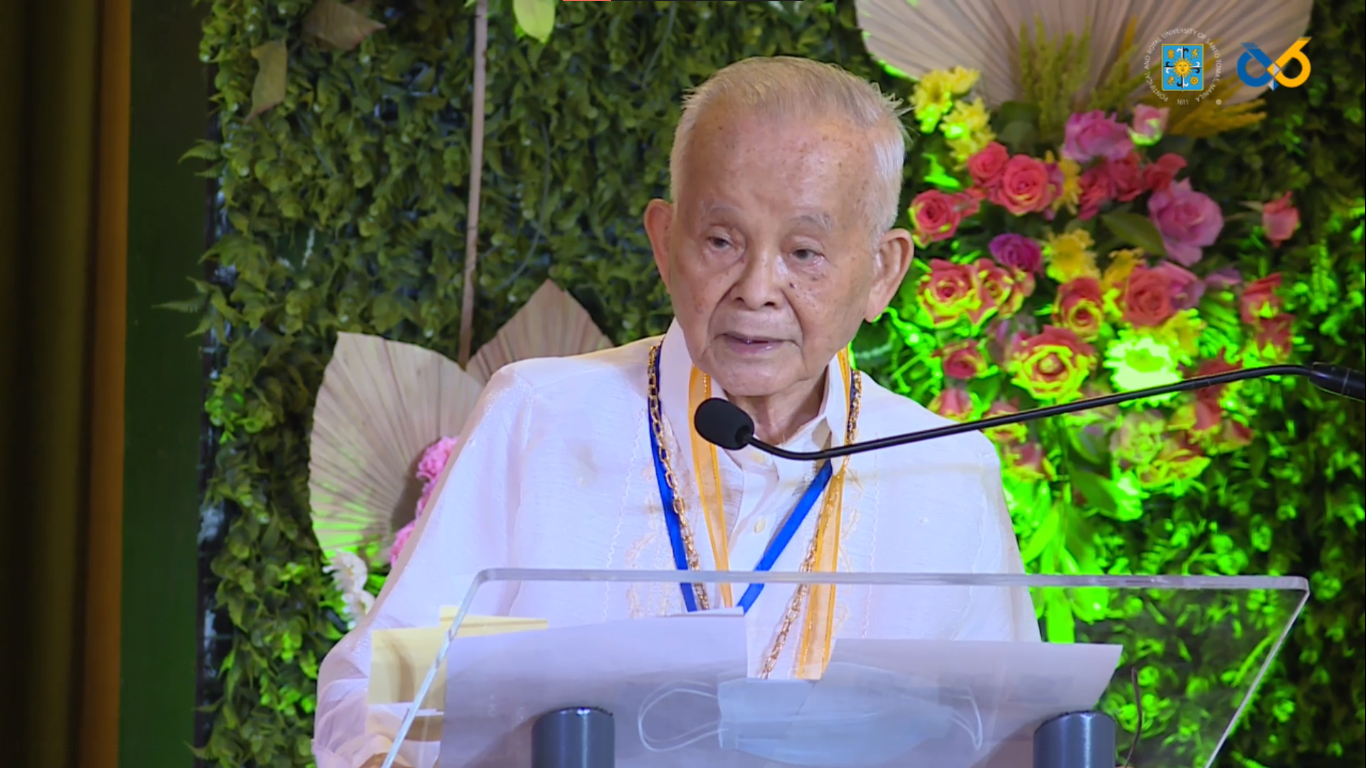
Thomasian journalist and educator Crispin Maslog delivers his speech during the UST 2022 Outstanding Alumni (TOTAL) Awards last May 14

AMIC Board of Directors Chair Dr. Crispin C. Maslog received the 2022 Thomasian Outstanding Alumni (TOTAL) Award for Media. The Award is the highest honor bestowed by the University of Santo Tomas (UST) upon Thomasian Alumni in recognition of their significant and exemplary contribution to the society and the Church.

Founded in 1611, UST is one of the oldest universities in the world.

Dr. Maslog received the coveted award on 14 May 2022 along with nine other outstanding alumni.

In his message, UST Rector Very. Rev. Fr. Richard, G. Ang, O.P., PhD called the Outstanding Alumni awardees as living treasures of the University and beacons of truth and charity. “Their respective contributions speak for themselves as they mirror the splendor of their true worth and dignity in God’s image. They are indeed living treasures of the University and living examples of what the University stands for: Veritas in Caritate,” Fr. Ang said.

Dr. Maslog expressed his gratitude to AMIC colleagues and friends who conveyed their best wishes, “You did make my day complete and outstanding. I hope to shake your hands again somewhere sometime.”

Maslog obtained his journalism degree from the University of Santo Tomas in 1956.  He obtained his MA and PhD in Mass Communication from the University of Minnesota, USA, as a Fulbright-Smith Mundt scholar.

He then returned to the Philippines to serve as the first Director of the Silliman University School of Journalism and Communication, in Dumaguete City, Negros Oriental, central Visayas, the first school/department of journalism/communication founded outside Manila and devoted to training professional journalists for the regional press.  Maslog focused his early research and writings on the need to strengthen the Philippines regional press.

After some 15 years at Silliman, Maslog joined the University of the Philippines Los Baños as professor and later the Asian Institute of Journalism and Communication in Manila as academic vice president. A prolific researcher, author and editor, he produced some 40 books.

AMIC observes World Press Freedom Day

AMIC observes World Press Freedom Day

AMIC observes World Press Freedom Day

AMIC joined the global community in commemorating this year’s World Press Freedom Day (WPFD) on 03 May 2022.

World Press Freedom Day (WPFD) was conceived in 1993 to remind people all over the world of the need to protect and defend press freedom at all times, especially in challenging times.

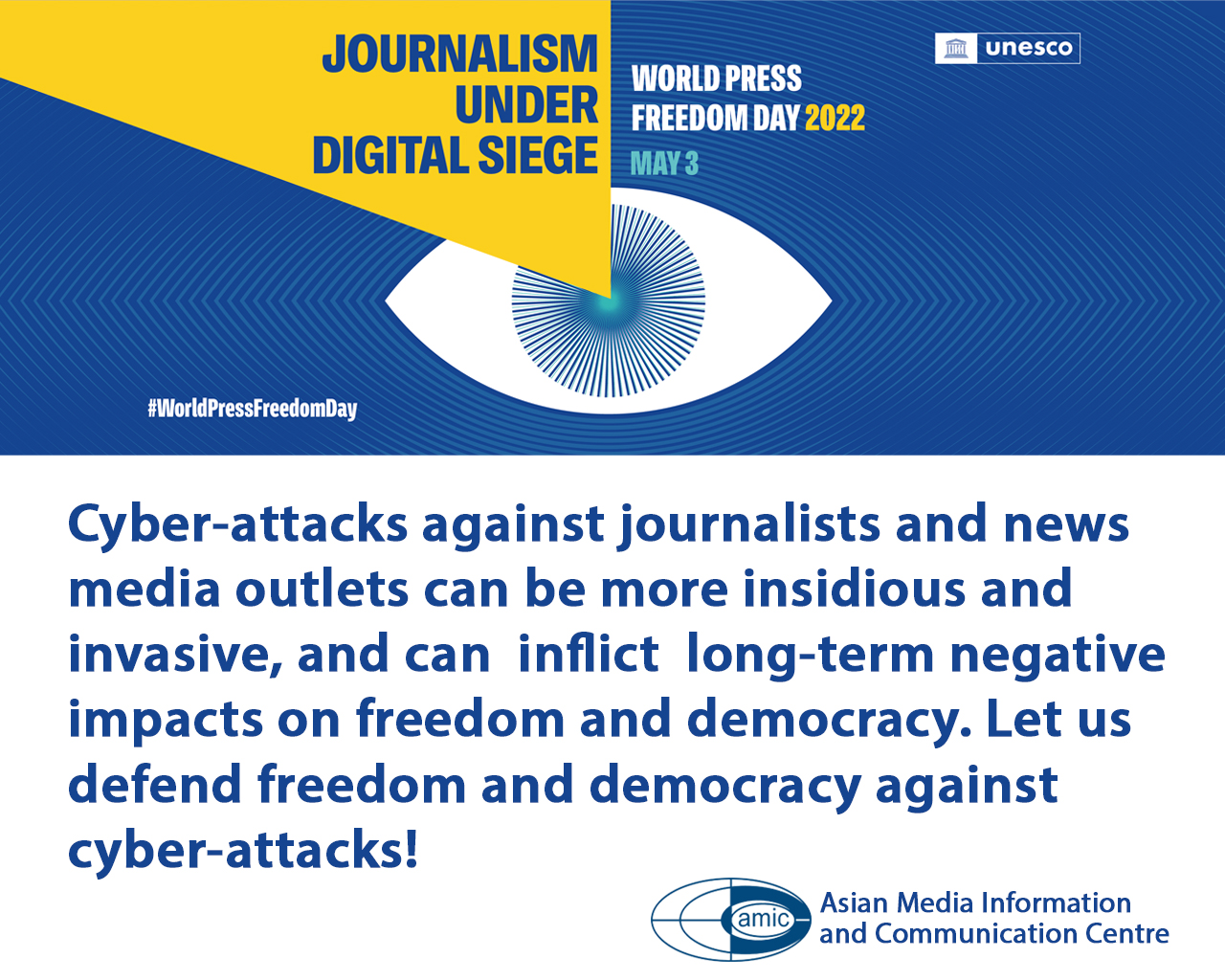
The theme of this year’s commemoration is “Journalism under Digital Siege.”  The objective is to spotlight the various ways by which advanced technology is being used in many countries to curtail press freedom.

Experiences from other countries reveal common forms of  cyber-attacks, including unlawful and targeted surveillance, cyber bullying (e.g., trolling), hacking, Distributed Denial of Service (DDOS), and internet shutdowns. 

The 2022 UNESCO WPFD Concept Note warns that surveillance operations undertaken by state and non-state actors can be more disproportionate, invasive, and longer lasting, without journalists being aware of them or being able to defend themselves. 

AMIC crafted and uploaded in AMIC Facebook and Instagram accounts five social media cards which highlighted the different cyber threats and attacks facing journalists and the need to continuously defend press freedom. AMIC also shared the social media cards to UNESCO headquarters in Paris, France.

About the Asian Journal of Communication

About the Asian Journal of Communication

About the Asian Journal of Communication

By Dr. Peng Hwa Ang, Editor

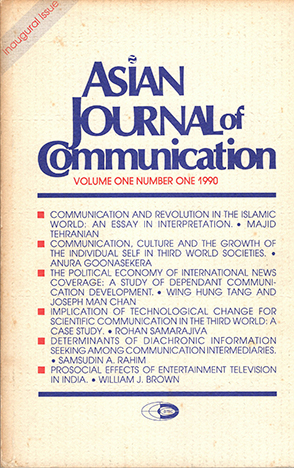
The Asian Journal of Communication is the flagship publication of AMIC. It was visionary venture by pioneering member Eddie Kuo and former research director of AMIC the late Anura Goonasekara.

From its very humble beginnings appearing twice a year from 1991, the Asian Journal of Communication now appears six times a year. It is co-published by AMIC and NTU. My University offers support in granting me as the editor a course waiver with a doctoral student as editorial assistant to handle administrative. The royalties go entirely to support AMIC.

The vision of the founding editors was for the Journal to be a voice of Asia in communication research. The mission is to publish academic research conducted rigorously but with an Asian perspective and an Asian voice. Manuscripts submitted must therefore have a link to Asia and advance theory in communication. So what types of work are outside the mission of the AJC. The following examples illustrate:

  • Empirical works are outside the mission of the journal. A study on the landscape of traditional and online media, while important for many purposes, will be published only if there is some interesting finding.
  • Replication of theories—using Asia as the source of data—would also be rejected. The research must advance theory in some way. Merely confirming a theory is not sufficient.
  • Research that merely use Asia as the data source may be rejected. For example, if the manuscript discusses theory in such a way that it appears to be intended for an international audience, an international journal, as opposed to a “regional” such as the AJC, might be a more appropriate forum.

The focus on theory in recent years has meant that scholarly essays—the kind that do not use hypotheses testing—had been left out. Scholarship in Asia, notably in India and China—has always recognized such essays. This year, we have appointed a review editor to look at such qualitative works.

We think we are on the right track. All the indicators of greater reach and citations are pointing up. As Table 1 below shows, the impact factor has been rising.

Table 1: Impact Factor of the AJC

  2019 2020 2021
Impact Factor 0.743 1.839 2.074
5-Year IF 0.982 1.817 1.963
Source: Clarivate, Journal Citation Reports 2020-2022 

I suspect the rise may be due to the wider reach as we have promoted published articles through social media—specifically Facebook and Twitter—with the help of our social media editor.

More recently, we have had researchers approach us with ideas for special issues. Among them is the recently published one on freedom of expression; an earlier one touched on Covid. Other special issues in the works address anti-Asian racism (not just in the West but also in Asia) and Islamic communication research.

Next Issue: How to avoid the desk-reject of your submission to a journal

Asian Journal of Communication’s journal ranking improves, Vol. 32, 2022, Issue 3 uploaded

Asian Journal of Communication’s journal ranking improves, Vol. 32, 2022, Issue 3 uploaded

Asian Journal of Communication’s journal ranking improves, Vol. 32, 2022, Issue 3 uploaded

Asian Journal of Communication (AJC), Volume 32, 2022, Issue 3, is now up and accessible online, while the journal is earning steadily rising scores in citation performance or Impact Factor (IF), according to Dr. Peng Hwa Ang, Editor in Chief.

Peng Hwa Ang announced that the Impact Factor (IF) of AJC has been rising, indicating improved non-self citation performance of the journal over a period of three years—from 0.743 in 2019, to 1.893 in 2020, and 2.074 in 2021. (Source: Clarivate, Journal Citation Reports 2020-2022)

“I suspect the rise may be due to the wider reach as we have promoted published articles through social media—specifically Facebook and Twitter—with the help of our social media editor,” said the Editor.

AJC, the flagship research journal of the Asian Media Information and Communication Centre (AMIC), was founded in 1991 as a platform for Asia-Pacific perspectives in communication research.  It appears six times a year and is co-published by the National Technological University (NTU), Singapore.

(For the full backgrounder on the Asian Journal of Communication by the Editor, click here.

(Here’s the link to the current AJC issue: https://www.tandfonline.com/journals/rajc20)

Media Asia’s journal ranking improves, publishes issues ahead of schedule

Media Asia’s journal ranking improves, publishes issues ahead of schedule

Media Asia’s journal ranking improves, publishes issues ahead of schedule

By Danilo Araña Arao
Editor, Media Asia

Media Asia continues to improve journal ranking as it publishes issues ahead of schedule.

Based on Scimago Journal & Country Rank data as of April 2022 (https://www.scimagojr.com/journalsearch.php?q=23067&tip=sid&clean=0), the quarterly journal’s highest quartile ranking is pegged at Q2 (Linguistics and Language). Scimago’s metrics are based on Scopus data which compute Media Asia’s CiteScore 2021 at 0.5 (https://www.scopus.com/sourceid/23067).

Aside from Scopus, the quarterly journal is abstracted and indexed in EBSCO Research Databases (Bibliography of Asian Studies, Associates Programs Source Plus, Communication & Mass Media Complete, Communication Source, Military Transition Support Center, Vocational Studies Complete); ProQuest (Business Premium Collection, Asian & European Business Collection, ProQuest Central, ProQuest Central Basic, ABI/INFORM Professional Advanced, SIRS Editorial, eLibrary); Dimensions; IngentaConnect; Portico; Informit full text content; and J-Gate.

Based on the final decisions on submitted manuscripts from 2020 to 2022 (as of April only), Media Asia’s acceptance rates are computed at 10.65% (refereed articles) and 46.31% (non-refereed editorials, commentaries and reviews).

As of the first semester of 2022, the March, June and September 2022 issues of Media Asia are already published. As early as now, the issue line-up for December 2022 is already final and is expected to be published ahead of schedule as well. The issue themes for 2022 are Unrest (March), Struggles (June), Body Biases (September) and Mediated Youth (December).

Since the current editorial board took over in 2020, the journal has had increased manuscript submissions while successfully being re-indexed in Scopus. It has also established its presence on social media through its Twitter account @MediaAsiaJourn.

Published since 1974, Media Asia is a peer reviewed quarterly journal that focuses on practices in journalism, advertising, public relations, entertainment and other aspects of media in Asia. It publishes relevant media-related studies in Asia like freedom, ethics, working conditions, ownership, campus press, community press, corporate media, alternative media, literacy, language and culture of impunity.