
Sep 29, 2016 | News
 AMIC Board Chair Crispin C. Maslog has lamented the “martial law amnesia” that has affected most Filipinos today, especially the millennials.
Maslog aired his concern in mass communication student convocations at the University of Santo Tomas September 17 and at the University of the Philippines Los Banos May 26, and over GMA’s Balitanghali news program aired Sept. 22.
During the Philippines’ martial law era from 1972 to 1981, human rights violations were rampant. The Marcos regime and its cronies plundered the Philippine economy. For these human rights violations and corruption, Marcos was ousted in 1986 by a peaceful Filipino “People Power” revolution.
Maslog warned against forgetting the past and allowing the Marcoses to return to power.
“Moving on without justice being served is not moving on – it is giving up,” reminded Maslog.
Maslog is a former journalist with Agence France-Presse, and former communication professor at Silliman University and University of the Philippines Los Baños.
Sep 28, 2016 | News
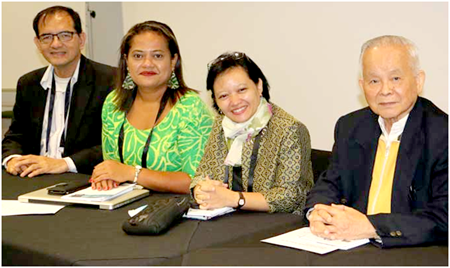
 AMIC Board Chair Crispin C. Maslog (right) and former AMIC Secretary-General Jose Ma. Carlos (left) join Vicky Lepou of Samoa (2nd from left) and Hermin Indah Wahyuni of Indonesia(2nd from right) during the World Journalism Educators Congress.
AMIC Board Chair Crispin C. Maslog (right) and former AMIC Secretary-General Mr. Jose Ma. Carlos participated in the fourth World Journalism Educators Congress held in Auckland, New Zealand, on July 14-16.
Dr. Maslog was sponsored by the New Zealand Foundation, while Joe Carlos was funded by the Pacific Media Centre in Auckland, headed by Dr. David Robie, AMIC Asia Communication Awardee in 2015.
The World Journalism Education Congress (WJEC), with the theme Identity and Integrity in Journalism Education, kicked off with a formal pōwhiri ceremony hosted in the Sir Paul Reeves building at the Auckland University of Technology (AUT).
AUT students perform a Maori traditional dance to welcome the delegates.
The traditional welcome was led by AUT students and staff. The conference brought together more than 220 media and journalism educators from 42 countries around the world for three days of discussions about global media challenges and education.
Dr. Maslog and Mr. Carlos participated in the panel on Post-Cop 21 – Journalism Education in Asia-Pacific: Responding to Key Issues on Climate Change. The panel, chaired by Robie, was unanimous in saying that there is a critical need to educate journalists in the region on the problems brought about by climate change, and for the schools to start offering courses on environmental reporting. So far very little is done in this area.
Dr. Maslog also joined another panel on Global Mass Communication and Journalism Research, chaired by Dr. Alex Tan of Washington State University in the U.S. The panel was meant to provide input to a book on research being planned by Dr. Tan.
The Congress voted on Paris as the site of the next WJEC Congress three years from now in 2019.
Sep 27, 2016 | AMIC Communication Awards
AMIC has reset the deadline for submission of nominees to its 2016 Asian Communication Award to 31 October 2016.
According to AMIC Secretary General Ramon R. Tuazon, the rescheduling will ensure that more nominees can vie for this prestigious award. The 2016 winners will be announced early next year.
Since 2006, 16 individuals have been recognized by AMIC for their outstanding achievements in various media and communication fields and categories.
The AMIC Asia Communication Award 2016 will be given in the following categories:
Research—pioneering contributions to the body of knowledge on media and communication research, such as the launching and completion of major research projects or the development of enduring theoretical approaches in the discipline;
Education—legacy in nurturing successive generations of media, communication, or journalism students and scholars;
Institution building—establishment of key communication and media programs, research centres or academic publications;
Excellence in journalism—sustained involvement in public service and observance of the highest journalistic principles; and
Outstanding practitioners from a single country within Asia-Pacific, a region within Asia, or the whole of Asia-Pacific can be nominated.
While the nominee need not be from Asia-Pacific, preference is accorded to regional actors.
Past awardees include eminent communicators and journalists Dr. John Lent, 2006; Prof. Eddie C. Y. Kuo, 2007; Dr. Nora Quebral and Dr. Florangel Rosario- Braid, 2008; Dr. Binod Agrawal and Dr. K. E. Eapen, 2009; Dr. Hidetoshi Kato, 2010; Dr. Georgette Wang and Dr. Crispin Maslog, 2011; Tan Sri Dato’ L. Krishnan, 2012; Dr. Alwi Dahlan and Mr. Jakob Oetama, 2013; Mr. Juan L. Mercado, 2014; and Dr. Alan Hancock and Dr. David Robie, 2015.
The award will be presented during the 2017 AMIC international conference in Manila, Philippines.
Nomination can be made by accomplishing the official nomination form (available at www.amic.asia), and submitting it with a nomination letter to:
Ramon R. Tuazon
Secretary General
Asian Media Information and Communication Centre (AMIC)
E-mail: r.tuazon@amic.asia or rrtuazon722@yahoo.com
Sep 26, 2016 | News
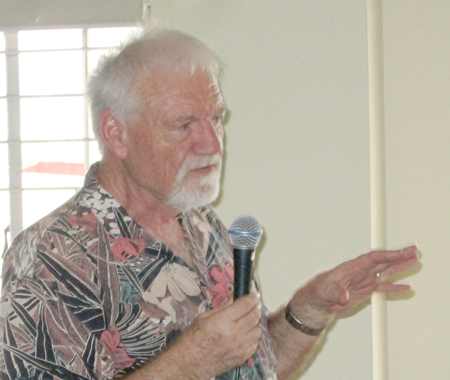
 Dr. David Robie, AMIC’s Asian Communication Awardee 2015, called for greater press freedom in the Asia Pacific in two talks he made while on a personal and business visit in the Philippines.
AMIC coordinated part of Robie’s tour.
As part of his Philippine tour, Robie spoke with the members of the AMIC Board of Management and urged greater networking in research, academic exchange, and joint projects among media organization in the Asia Pacific region, especially among higher education institutions.
These were among the recommendations raised during the World Journalism Educators Congress (WJEC) held in Auckland, New Zealand in July. Robie is a professor of media and communication at the Auckland University of Technology which hosted the WJEC. He is head editor of AUT’s School of Communication’s Pacific Media Centre.
In his talk at the Asian Institute of Journalism and Communication, Robie underscored the need to support journalists on account of strict rules governing the media in some areas of the region. He cited the case of the Balibo 5, a group of young journalists who disappeared in West Papua in the 1970’s after attempting to conduct an investigative video report in this embattled area.
At the University of Santo Tomas, Robie spoke at the forum Asia-Pacific Journalism for Filipinos Lessons by Seasoned Journalists and Journalism Educators where he emphasized truth as the core of journalism.
“Journalism is really about truth, any experience of truth, and establishing that truth,” Robie said, while urging an audience full of students to adopt a digital strategy to promote human rights for journalists.
He cited the Pacific Media Center that runs the news website Asia Pacific Report as an example of independent campus based media.
AMIC coordinated Robie’s visits to the Center for Media Freedom and Responsibility and the Philippine Center for Investigative Journalism, two media advocacyorganizations based in the Philippines.
Aug 27, 2016 | Asian Journal of Communication, Media Asia, Publications
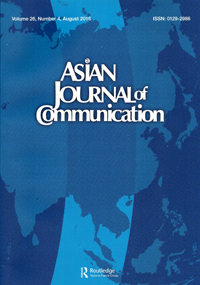
Four 2016 issues of Asian Journal of Communication (AJC) and one Media Asia issue are already out.
AJC Vol. 26, No. 4 (August 2016) contains articles probing communication styles in different areas of the world, such as comparing the presidential rhetoric of South Korea President Lee and US President Barack Obama.
Theoretical articles are presented, such as probing moderating role of cultural orientation in explaining temporal orientation of self-referencing, and examining a new contextual perspective for crisis communication theory comparing the Eastern and Western traditions.
Communication issues that have arisen in specific countries are also probed, such as an examination of Chinese media’s implicit and explicit agendas; changes of cultural representation in Indonesia’s children’s television from 1980s-2000s; and examining the impact of message framing and temporal distance related to the communication to young Chinese of the human papilloma virus.
The AJC August 2016 issue also contains a book review of Making news in India: Star news and Star Ananda, written by SomnathBatabyal and published by Routledge.
Meanwhile, Media Asia Vol. 43, No. 1discusses the national anniversaries of Philippines and Indonesia as “narratives of remembrance”, with an interview of Dr. Crispin C. Maslog, AMIC Board of Directors chairperson, remembering the People Power Revolution. It contains two articles on what happened in Indonesia in 1965 when the Sukarno government was overthrown.
Articles also include a discussion of Japan press clubs, a Chinese dating show, television in India, reporting on the Malaysian Airline MH370 tragedy, border radio in Thailand and Malaysia, Indian Media Organization, and social media influencers in Singapore.
