2022 AMIC Asia Communication

2022 AMIC Asia Communication

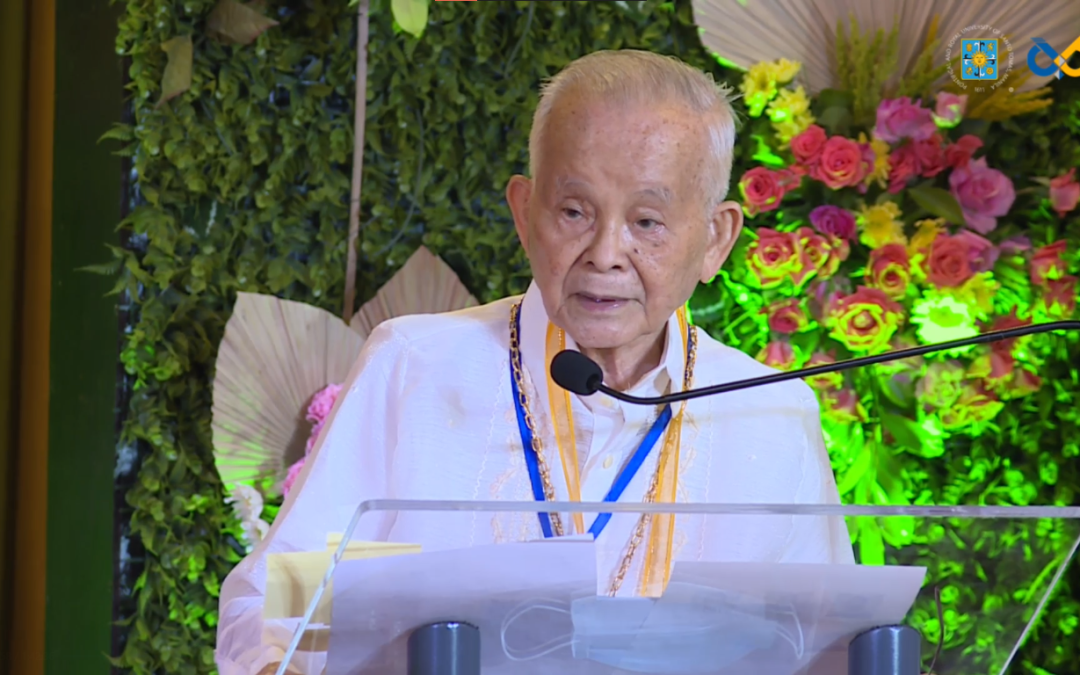
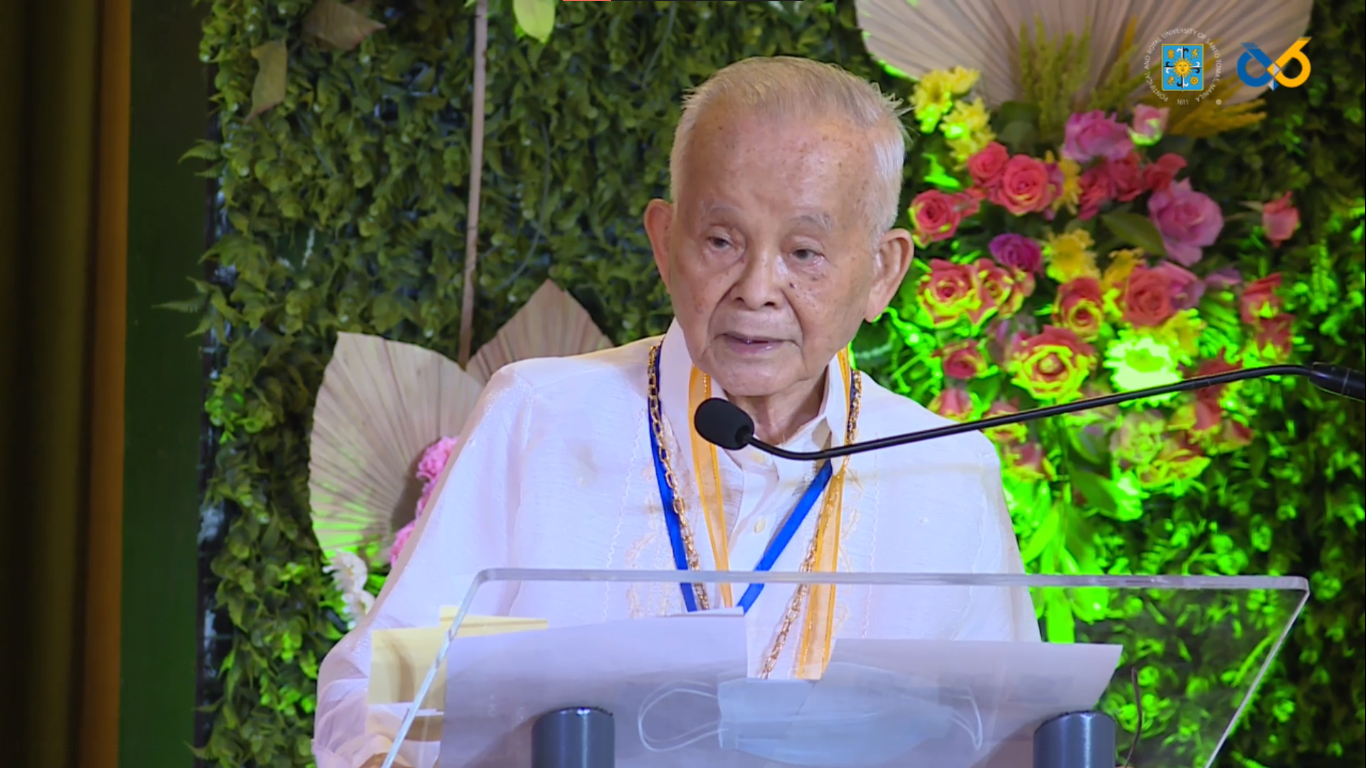
Ronny Adhikarya is 2022 AMIC Asia Communication Laureate

THE Asian Media Information and Communication Centre (AMIC) announces the selection of Dr. Ronny Adhikarya as recipient of the 2022 AMIC Asia Communication Award for Transformative Leadership.

The award is given to individuals who have made “significant contributions to Asian communication,” said Dr. Crispin C. Maslog, chairperson of the AMIC Board of Directors and of the board of judges for the selection.

Dr. Adhikarya has a Master of Professional Studies degree from Cornell University’s Department of Communication Arts, and a PhD from Stanford University’s Institute for Communication Research. He has had a 50-year career in international development assistance, specializing in communication, education and training. 

He was a Senior Trainer and Manager at the World Bank in Washington D.C., USA, and served as Country Director at the United Nations Food and Agriculture Organization in Rome, Italy and in Islamabad Pakistan. He also worked for other international organizations worldwide, undertaking official Missions in 52 countries, and visiting 103 countries, thus far. 

He was associated with Universiti Sains Malaysia (USM), Stanford University, East-West Center, and other universities in many countries. 

He is often invited as keynote speaker at international conferences, and has given public lectures in at least 28 countries from 2005 to2022.  His wide- ranging topics include challenges of digital disruption, Artificial Intelligence-technology-based applications, and its impact on education, business (including start-ups), shared economy, virtual education and communication, tacit knowledge brokering, edupreneurship, generational conflicts, and societal and cultural cohesion. 

Originally from Indonesia, Dr. Adhikarya was an award-winning journalist for Daily Indonesia Raya from 1968 to 1971. He has written eight books on communication, education, and training which were published in Singapore, Indonesia, Malaysia, Germany, Italy, England, and the USA. These books and his other publications are available in English, Spanish, French, Indonesian, Malaysian, and Chinese languages. 

Dr. Adhikarya has served various advisory boards and committees of international development organizations in Singapore, Thailand, Indonesia,  England, Switzerland, and the USA.

He established the R-Adhikarya “Niche” Awards (RANA) at the East-West Center (EWC), Stanford University and Cornell University. The annual RANA Program Scholarship rewards and recognizes smart, innovative, and competitive young students who wish to pursue their dreams to learn, explore, and apply disruptive ideas, and “niche” innovative thinking, in their studies and future careers. 

Guru for decolonizing journ/com education

Guru for decolonizing journ/com education

Guru for decolonizing journ/com education

Philippine communication “guru” Dr. Crispin C. Maslog, the first Filipino journalist to acquire a doctorate in mass communication, has proposed a drastic revision of the way Philippine journalism has been taught and practised in the Philippines.

In a lecture to communication students and practitioners at the University of Santo Tomas, his alma mater, last December 10, Maslog said that the first Filipino journalists and journalism students were taught by the early American journalists to practice and teach journalism in the Philippines the American way.

American Journalism

“Go direct to the point—present the 5 Ws and 1 H. Who, what, where, when, why and how. Don’t beat around the bush,” the early American practitioners said.

Among them were the pioneers in Philippine journalism in English–American Carson Taylor of Manila Bulletin, the oldest English language newspaper in the Philippines, and Scotsman Robert McCullough Dick of the Philippines Free Press.

Among their first English journalism disciples were Teodoro M. Locsin Sr., Armando Malay, Ramon Roces, Max Soliven and Teodoro C. Benigno. The Manila Bulletin, Manila Times and Manila Chronicle led the way in early Philippine journalism.

The first Filipino communication scholars to the U.S. under the Fulbright-Smith Mundt, Rockefeller and Ford scholarship programs–including Maslog, Nora Quebral, Juan Jamias, Gloria Feliciano, Josefina Patron and Fr. Alberto Ampil, S.J.– were trained in English journalism and mass communication and returned to set up the first English mass com programs in the country.

The University of Santo Tomas established in 1936 a journalism major within its Faculty of Philosophy and Letters and taught English journalism with a vengeance, offering seven English journalism/writing courses in its undergraduate degree program alone. And the medium of instruction was English.

The tradition of English journalism was thus established in the post World War II years and Filipino students became disciples of European and American schools of communication.

American Indian and Filipino Communication

Maslog said it took his two-year experience teaching communication and living on an American Indian Reservation in Fort Yates, South Dakota, in 2008-2010 to discover that Philippine culture was different from white American culture, and Filipino ways of communication were different from the white man’s ways.

There are more similarities between Filipino and American Indian culture and communication.

They share values such as strong family ties, respect for the elderly, humility, generosity, sense of gratitude, honor, humor, wisdom and love for education.

He also said the Native Americans have a unique style of oratory, which is indirect, non-confrontational, consensual, respectful and humble. This style resembles the traditional Filipino way of communication before the Westerners came to the Philippines.

Media Asia increases citations, sustains fast turnaround time in its golden year

Media Asia increases citations, sustains fast turnaround time in its golden year

Media Asia increases citations, sustains
fast turnaround time in its golden year

By Danilo Araña Arao
Editor, Media Asia

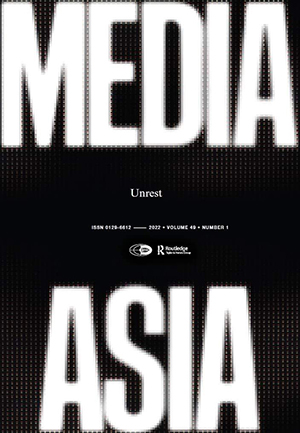
As Media Asia celebrates its 50th year in 2023, the journal’s citation metrics show improvement as the turnaround time is sustained.

The journal’s latest CiteScore (https://www.scopus.com/sourceid/23067) has improved to 0.8 as of January 5, 2023. Based on Scopus data, this score is based on Media Asia’s 52 citations out of 65 indexed documents to date.

When the new editorial board took over in 2020 and Media Asia got re-indexed on Scopus, the CiteScore ranged from 0.0 to 0.5.

For the past three years, the five most cited articles were published in 2020 and 2021. They all focus on media and the COVID-19 pandemic (https://www.tandfonline.com/action/showMostCitedArticles?journalCode=rmea20).

In 2022, new manuscript submissions increased by 10.6 percent compared to 2021. This is the case even if the latest rejection rates are pegged at 84.93 percent (refereed articles) and 58.47 percent (non-refereed editorials, commentaries and reviews).

Based on unsolicited feedback from some authors, they seem to appreciate the relatively quick turnaround time (TAT) that does not compromise the quality of editorial and peer reviews. As of this writing, the average TAT from submission to online publication for refereed publications is 214.00 days. On the other hand, the average TAT for non-refereed ones is 49.96 days.

Media Asia is a peer reviewed journal that focuses on practices in journalism, advertising, public relations, entertainment and other aspects of media in Asia. The journal’s editorial board is composed of nine women and four men who are based in nine locations in Asia, Europe and North America.

The Editor is Danilo Araña Arao (University of the Philippines Diliman, Philippines). The Associate Editors are Lisa Brooten (Southern Illinois University Carbondale, USA), Roselyn Du (California State University Fullerton, USA), Paromita Pain (University of Nevada Reno, USA), Ma. Theresa M. Rivera (Far Eastern University Manila, Philippines) and Nick Y. Zhang (Hong Kong Baptist University, Hong Kong).

The members of the Editorial Advisory Board are Sarah Cardey (University of Reading, UK), Ataharul Chowdhury (University of Guelph, Canada), Minjeong Kim (Hankuk University of Foreign Studies, South Korea), Eunice Barbara C. Novio (Vongchavalitkul University, Thailand), Sheau-Wen Ong (Wenzhou-Kean University, China), Deborah N. Simorangkir (Swiss German University, Indonesia) and Tom Sykes (University of Portsmouth, UK).

AMIC Chair honored by UPLB-CDC

AMIC Chair honored by UPLB-CDC

AMIC Chair honored by UPLB-CDC

Dr. Crispin Maslog, Chair, AMIC Board of Directors, was honored by the University of the Philippines Los Banos – College of Development Communication as one of its luminaries during its 24th anniversary celebration last December 19, 2022. Maslog had been in the UPLB-CDC faculty for many decades.

The college launched the Legacy Corner, a special spot in its Reading Room which will house the works of “Devcom luminaries,” including Dr. Maslog’s textbook collection, which he donated to the college.

The Maslog collection includes 41 books he authored and other journalism and communication books. Signed copies of his books are available for sale. After the launching, Maslog delivered a speech through a hybrid event entitled, “Devcom: A Many Splendored Thing,” where he shared his journey as a scholar and practitioner. Among those in attendance were CDC Dean Maria Stella C. Tirol, faculty, staff, and students.

New AMIC history book just out

New AMIC history book just out

New AMIC history book just out

AMIC@50: Turning Gold, A History of the Asian Media and Information Centre,  has just come out in December 2022. This 272-page book commemorates the golden jubilee of AMIC, the main association of communication educators in Asia, founded by 13 communication educators in a unique travelling seminar to 11 cities in Asia in September 1971.

The book narrates the founding and development of AMIC by the first secretary-general Lakshman Rao and the contribution of succeeding SG’s—P.R. Sinha, Vijay Menon. Jose Ma. G. Carlos, Indrajit Banerjee, Sundeep R. Muppidi, Maria Mercedes F. Robles, Martin Hadlow, and Ramon R. Tuazon. American scholar John Lent has contributed an epilogue.

It is edited by Crispin C. Maslog, current AMIC chair of the board, who is one of two surviving members of the travelling seminar. The book is informative and loaded with historical facts, but is easy to read and illustrated with pictures.  It is available at Shopee and at the AMIC office at Philippine Women’s University, Taft Ave., Manila. Price: P550. ###

__________________
Source: Ramon G. Tuazon, rrtuazon722@yahoo.com/CP 0920-926-0963
Asian Media Information and Communication Centre, PWU, Taft Ave., Manila