AMIC joins World Press Freedom Day


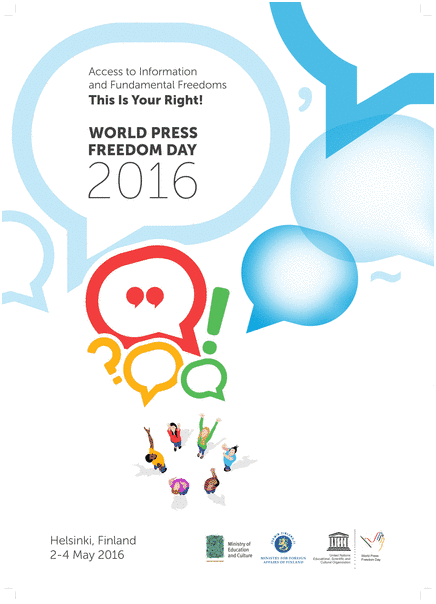
AMIC joins the commemoration of World Press Freedom Day (WPFD) on May 3, 2016. The theme of this year’s WPFD commemoration is “Access to Information and Fundamental Freedoms: This Is Your Right!”
AMIC noted that many violations of press freedom have taken place in the Asia Pacific, the most dangerous region in the world for journalists according to a February 2016 report by the International Federation of Journalists (IFJ). In this connection, AMIC plans to conduct a study on policies and programs related to safety of journalists in the region.
The IFJ noted that since 1990, the Asia Pacific has registered the highest death toll of journalists and media professionals at 571. This translates to a regional average of 23 media killings a year. The region’s record is followed by the Middle East with 473 killings, the Americas at 472, Africa at 424, and Europe with 357 dead.
This year, UNESCO and the Government of Finland are co-hosting the WPFD main event and the UNESCO/Guillermo Cano World Press Freedom Prize awarding ceremony in Helsinki, Finland, from May 2 to 4.
At the same time, UNESCO and the UNESCO Chair at University of Gothenburg are co-organizing on May 3 to 4 the Research Conference on Safety of Journalists in collaboration with the University of Sheffield, University of Helsinki, and University of Tampere.
The World Press Freedom Day celebrates the fundamental principles of press freedom by evaluating the state of the press around the world to defend the media from attacks on their independence and pay tribute to journalists who have lost their lives in the exercise of their profession.
The World Press Freedom Day was proclaimed by the UN General Assembly in 1993 following a recommendation adopted at the 26th Session of UNESCO’s General Conference in 1991.
To better understand and act on the issue of safety, UNESCO is promoting a research agenda on the safety of journalists. In 2015, an academic research agenda on safety of journalists was developed to strengthen academic research on the issue and cooperation with academia in line with the UN Plan of Action on the Safety of Journalists and the Issue of Impunity.

 AMIC Secretary General Ramon R. Tuazon attended the 38th session of the UNESCO General Conference at the UNESCO headquarters in Paris, France held on 10-11 November 2015. He represented the Philippines at the Communication and Information Commission.
During the session, Secretary General Tuazon commended UNESCO’s unrelenting efforts to promote the safety and protection of journalists worldwide, including its lead role in promoting the “UN Plan of Action for the Safety of Journalists.”
Asserting that an effective criminal justice system is a strong deterrent to impunity, he called on the UN body to complement safety and protection initiatives with programs that strengthen the criminal justice system and promote the rule of law.
SG Tuazon also had one-on-one discussions with UNESCO officials, including Director Guy Berger of the Freedom of Expression and Media Development Division and Director Indrajit Banerjee of the Knowledge Societies Division. Dr. Banerjee is a former AMIC Secretary General.
After the Paris conference, he proceeded to South China Normal University, Guangzhou, People’s Republic of China. He was resource person on Media and Information Literacy (MIL) during a seminar of the UNESCO Resource Distribution and Training Centre(RDTC) held 11-13 November 2015.
The seminar theme was “Teacher Training to Promote Safe, Effective and Responsible Use of ICT.” It was participated in by 35 deans and professors from several teacher education institutions (TEIs) in the Asia-Pacific region.
SG Tuazon encouraged the TEIs to integrate MIL in their respective teacher training curriculum to equip educators with necessary competencies needed not only to teach the course but also to mentor young people on MIL even outside the classroom.
The AMIC Secretary General then facilitated two workshops on Media and Information Literacy (MIL) for 30 leaders of Myanmar civil society organizations (CSOs).
Held on 14-15 and 16-17 December 2015 in Yangon, the workshop series was organized by UNESCO Myanmar.
Media Asia 2015 Vol. 42, No. 1-2, has already gone out of press.
Media Asia 2015 Vol. 42, No. 1-2, the first issue for 2015, is being published as a double issue.
The publication of Media Asia slowed down in 2015 as Taylor and Francis, AMIC’s co-publisher, also has to build its systems in handling the production of both the online and print journal.
The AMIC Secretariat also transferred from Singapore to Manila in late 2014.
AMIC transferred the production of Media Asia to Taylor & Francis so as to benefit from its strong distribution capabilities.
According to Prof. Cherian George, Media Asia’s editor-in-chief, AMIC members will see the benefits of the change starting in 2016.
In addition to several original research articles, Media Asia Vol. 42, No. 1-2 includes two interviews with scholars on the perennial problem of religious extremism and intolerance.
In this issue, Prof. Romila Thapar, one of India’s most eminent historians, discusses how right-wing harassment has narrowed the space for academic historians.
Meanwhile, Malaysian scholar Farish Noor talks about religious extremism in Southeast Asia, in the context of Islamic State’s internet savvy outreach in the region.
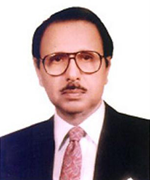
 AMIC joins other media organizations in mourning the death of Bangladeshi mass communication expert and journalist Prof. Khairul Bashar who espoused using communication tools for poverty alleviation, social advancement and promotion of human rights