Aug 20, 2018 | Member Updates, News
Dear AMIC officers and members,
It is with deep regret that we announce the passing of GERARDO “Gerry” R. JOSUE on 12 August 2018. Gerry was a member of the AMIC Board of Directors and AMIC Country Representative to the Philippines. AMIC recognizes the many contributions of Gerry to the organization especially in institution building and program planning.
AMIC has extended its condolences to the immediate family of Gerry and has co-organized on 15 August a necrological service to honor our dear colleague and supporter. His contemporaries have also expressed their appreciation for Gerry.
“He was a gentleman and a great friend to have. During my stint as AMIC’s SG, Gerry was also a very supportive board member and always a pleasure to work with.” – Sundeep R. Muppidi, Ph.D.
“It is with deep sadness that I learnt about the passing away of our dear friend and AMIC Board member Mr. Gerry Josue. Gerry was an extremely decent and dignified person who was deeply committed to AMIC and provided me with invaluable support during my tenure as AMIC SG.” – Indrajit Banerjee , Ph.D.
We invite our AMIC officers and members to offer prayers for the repose of his soul.
Thank you very much.
Sincerely yours,
RAMON R. TUAZON
Secretary General
Aug 9, 2018 | News
The internship/on-the-job training program is a project-oriented learning opportunity for undergraduate students to gain experience through assignments based on AMIC’s current operational needs.
AMIC advertises its internship assignments once a year and welcomes driven, creative, and self-directed individuals to apply.
The program offers students the opportunity to
- Work for 250-400 hours in a major international association for communication, professionals;
- Work collaboratively with other trainees/interns on industry-relevant assignments;
- Gain a deeper understanding on management of social media platforms, corporate website, contact lists and databases; production of marketing collaterals; and email marketing;
- Contribute to AMIC through various program and administrative tasks; and
- Receive complimentary access to the library of AMIC and the Asian Institute of Journalism and Communication (AIJC) from the start of the program until three months after the date of completion.
Internship candidates must be
- Currently enrolled in an undergraduate-level program (Communication, Journalism, Advertising or other programs directly related to AMIC’s work);
- Competent in English oral and written communication; and
- Adept at using MS Office and similar applications.
By the end of the program, the trainee/intern will be able to learn
- Basic email marketing and correspondence;
- Management of contact directories (media, higher education institutions, Public Information Offices, nongovernment organizations, AMIC members) and other data;
- Content management of social media accounts (LinkedIn, Facebook, Twitter, Instagram);
- Website development and maintenance;
- Design and layout of corporate collaterals;
- Product photography and basic photo retouching; and
- Other basic skills in the workplace such as recordkeeping and file management, drafting minutes of meetings, and preparing audio transcriptions.
Application Process
The internship application process is online through the AMIC Secretariat. Eligible candidates may apply by sending their CVs, three sample written works, and the contact information of their internship/OJT coordinator, together with a cover letter, to f.academia@amic.asia.
Deadline of submission is on August 30, 2018. Applications submitted after the deadline will not be considered.
To avoid errors in submission, applicants are advised not to wait until the last day of the application period in submitting their internship applications.
AMIC evaluates applications based on eligibility requirements, relevance of academic background, and the candidate’s level of interest and motivation to contribute to AMIC’s work.
Only shortlisted candidates will be contacted.
Jul 6, 2018 | Member Updates, News
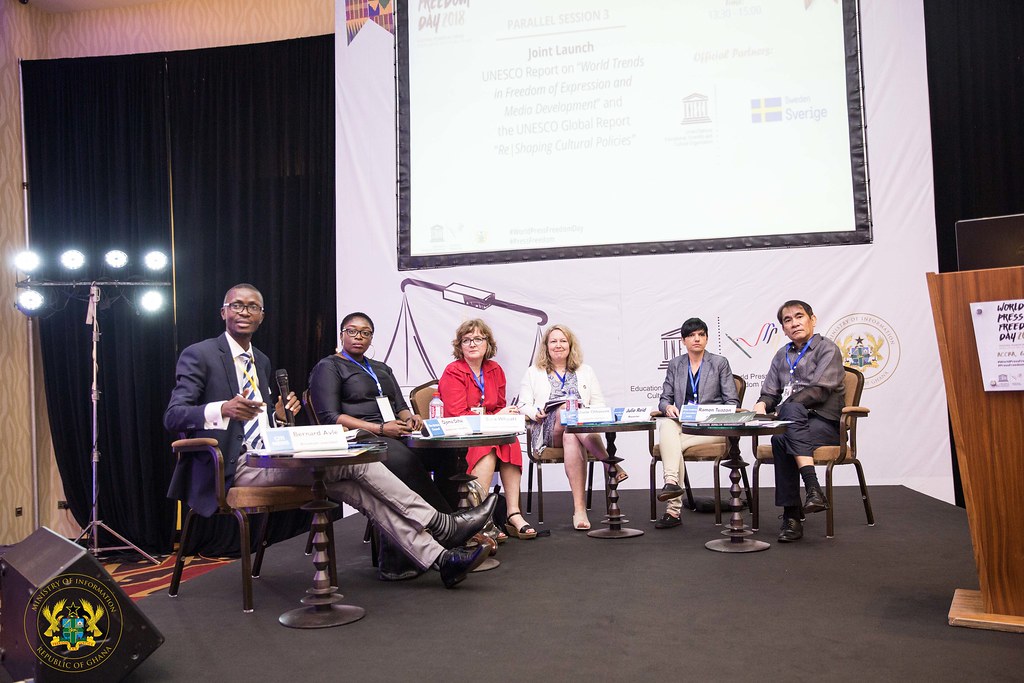
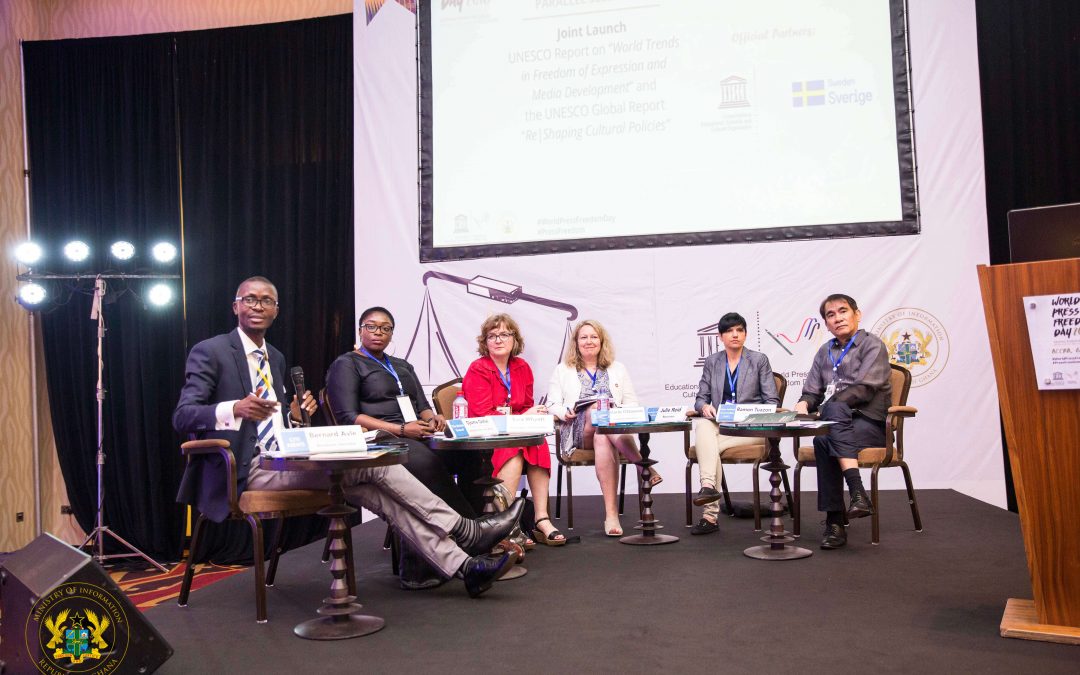
AMIC Secretary General Ramon R. Tuazon joined three panels organized by UNESCO in the recently convened 2018 International Association of Media and Communication Researchers (IAMCR) held at the University of Oregon on June 20-24, 2018. The three panels were “Wither the Communications Landscape in the next five years?,” New Challenges, New Curricula: Media Education in the Face of Disinformation and Attacks on Journalists,” and “Attacks on Journalists and the Issue of Impunity: The Fight for Sustainable Journalism against Civil Diminishment.”

R. Tuazon, L. Obonyo, O. Adekunle Suraj, A. Vega Montiel, M. Pathak-Shelat and R. Mansell. © UNESCO
According to Tuazon, journalists’ safety is being compounded by the evolving ecosystem of violence against journalists in many parts of the world and the lack of public awareness, or worse public apathy, on the issue. He emphasized that safety competencies have emerged as new core competencies of journalists which should be integrated in journalism curricula.

Panelists of New challenges, new curricula: Media education in the face of disinformation and attacks on journalists . © UNESCO
On the issue of impunity, he called for more interdisciplinary research especially the impact of political economy on the workings of media. He also urged the UNESCO and the academia to further engage young people to make them active stakeholders in pushing back sustained efforts to attack freedom of expression. SG Tuazon cited the recent 2018 AMIC Annual Conference with the theme “Disturbing Asian Millennials: Some Creative Responses.” The AMIC event was held in Karnataka, India and was hosted by Manipal Academy of Higher Education (see related story).
During the conference, SG Tuazon had separate one-on-one meetings with UNESCO Director Guy Berger of the Freedom of Expression and Media Development Division and Dr. Janet Wasko, IAMCR president. They discussed partnership opportunities in the areas of research, publications, and training.
Among the other AMIC stalwarts who attended the IAMCR 2018 were AMIC Board of Director Binod Agrawal and AMIC Lifetime member and AMIC Asia Communication laureate John Lent. A number of AMIC members who attended the conference expressed their delight to SG Tuazon that AMIC has become more visible again in the past few years. SG Tuazon invited the members to be active in future AMIC events especially the 2019 AMIC Conference in Bangkok, Thailand.
Other related articles:
https://en.unesco.org/news/experts-debate-global-trends-freedom-expression-and-media-development
https://en.unesco.org/news/journalism-curricula-welcomed-academic-conference
More photos by UNESCO Communication and Information HERE
Jul 2, 2018 | Annual Conference, News
By David Robie
June 12, 2018
India’s “alternative” freedom and democracy empowerment in action … as portrayed at the AMIC2018 communication conference at Manipal University, Karnataka.
BRIEFING: By David Robie in Manipal, India
“Fake news” combined with a lack of critical media judgment by many in the millennial generation is a major challenge to democracies across the world, says a leading Indian communication academic.
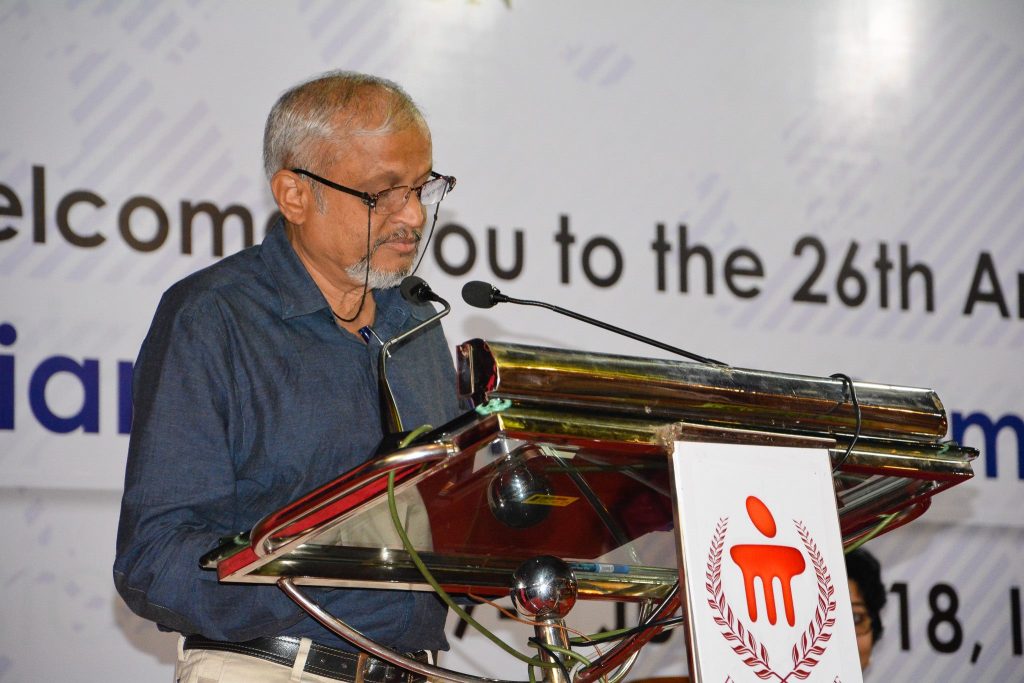
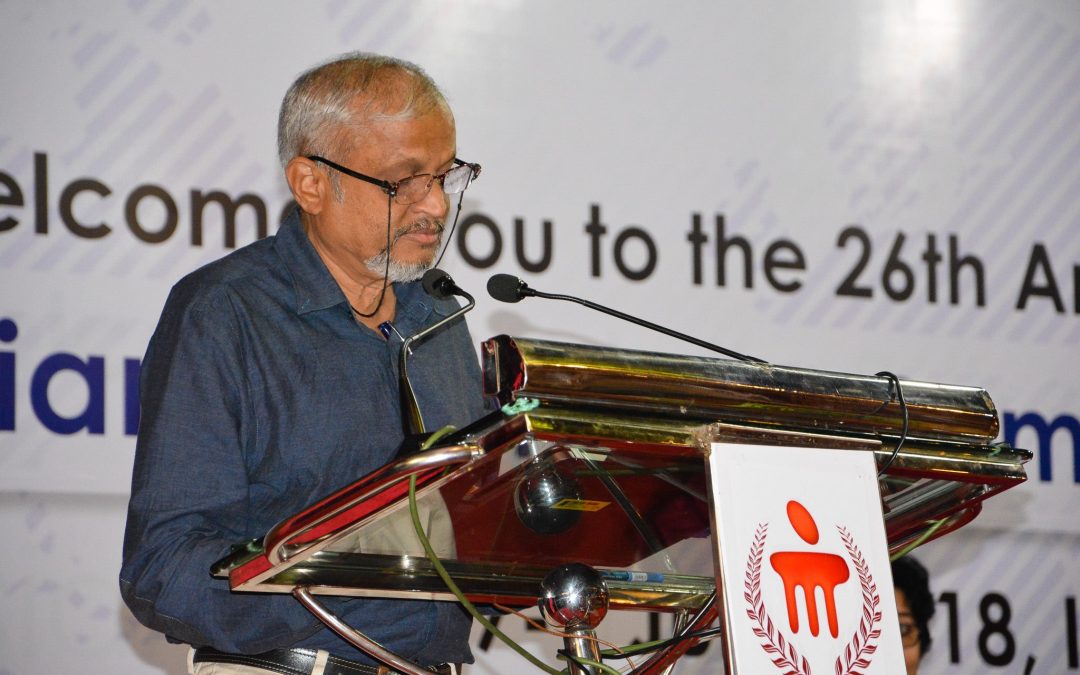
Professor Sanjay Keynote Address at the 26th AMIC Annual Conference
Speaking at the 26th annual conference of the Asian Media Information and Communication Centre (AMIC) conference with the theme “Disturbing Asian millennials: Some creative responses”,Professor Bharthur Sanjay, pro vice-chancellor of the University of Hyderabad, said the vulnerability of some states in the face of the social media crisis had led to a default response of shutting down the internet in “volatile contexts”.
In the case of India and some states, efforts to formally regulate fake news with legislated responses were withdrawn.
READ MORE: Professor Sanjay’s full address
Papua New Guinea is an example of an Asia-Pacific country where a government minister has threatened to shut down Facebook for a month to research so-called “fake accounts”.
Professor Sanjay did not mention Papua New Guinea but he said the implications were wide-ranging for Asia-Pacific countries. Papua New Guinea is due to host APEC in November.
The WhatsApp social media platform – widely used throughout Asia – was cited as a leading outlet for disseminating fake news.
“Fake news” is a misleading term because of its wide-ranging intepretations, says Professor Sanjay of the University of Hyderabad, at AMIC2018. Image: David Robie/PMC
“Fake news is a bit of a misleading term, as fake news can mean many things – a mistake, intentional misleading, twisting a news story, or fabricating a complete lie,” Dr Sanjay said, quoting Pankaj Jain, one of India’s most active ‘fake news slayers’..
Fake accounts damage
In the opening address at the host Manipal University (MAHE) in Karnataka, South India, Dr Sanjay said that while news media organisations and credible journalists had been found to publish misleading stories and mistakes, the most damage was done by people with fake social media profiles, polarising websites, and social media sites seeking to intentionally spread fake news to win elections or promote hatred.
Formal education contexts featured debates about the public sector, commercialisation and privatisation while a “default faith” was placed on new media that could virtually bring “handheld” education to the millennials.
This was a field that the public and private education sector intended to reach out to through online education and learning tools and options, said Dr Sanjay.
He said the euphoric underpinnings of the digital era in the Asia-Pacific and its subregions of ASEAN countries, South Asia and the Southeast Asia had parallels in the colonial and postcolonial periods with a technocentric dimension.
Dr Sanjay said online Indian language context was expected to reach about 60 percent.
Digital destinations across genres would capitalise on the profile that was non-English.
Information was considered an enabling and empowering input.
The speed with which it travels through multiple platforms has raised concerns about legacy media content through adaptation or user-generated content, Dr Sanjay said.
Higher trust
Apart from ethics, the legacy media enjoyed higher trust based on its screening and verification processes.
User-generated content reflected a paradigm shift that in theory allowed higher participation.
The millennials profile was not uniform across countries and the kind of content had come into sharper focus.
A critique of the content was an issue for both academic discourse and legal and regulatory frameworks, Dr Sanjay said.
Extension models of higher education seemed to suggest that they could be tapped to bring skilled youth into the workplace.

Speakers in the opening AMIC2018 plenary on “Millennials – concept of democracy: Freedom of expression for all v. Freedom of expression for themselves”.
AMIC chairman Professor Crispin Maslog of the Philippines said the millennials were the largest such generation in history – “and we ‘centennials need to understand them’.”
“There are some 1.8 billion out of the 7 billion global population – and they love smart phones. Of that 1.8 billion, 600 million are Asian.”
Redefining millennial life
Millennials, sometimes known as the “echo boomers”, are generally regarded as the 16 to 34-year-olds – the “digital natives’ who are not just consumers of media, but produce their own media content.
Globalisation, migration and technology are some of the major factors redefining the millennials’ way of life.

Pacific Media Centre’s Professor David Robie speaking in a plenary session at the AMIC2018 conference.
Most of the 200 academics from 15 countries at the conference presented papers on millennials education research and innovative case stories.
Themes explored included “Branding millennials – defining identity”, “A passion for technology – living in a social media world”, “News and current affairs as consumption (or creation) practices”, “evolving gender representation in the new mediascape”, and “Research and data management – today’s cutting edge competencies”.
One of the conference highlights was a “Free/Dem” panel dialogue and presentation about communication for and by young people in practice.
Giving Indian girls from poor communities a technology chance in life … teenager Summi of FAT speaking at AMIC2018. Image: David Robie/PMC
Deepika and Summi, programme associates of India’s Feminist Approach to Technology (FAT), gave inspiring addresses in Hindi about how their movement had worked across the continent to give girls in poverty-hit communities the opportunity to work with computers and learn technical skills.
“When I saw people using computers, I wanted to be able to do the same,” said Summi, a 13-year-old from a very poor urban neigbourhood where girls never got an opportunity.
“Now I am able to help other girls to do the same.”
One of the performers in the Yakshagana Kendra cultural show at AMIC2018. Image: David Robie
Creative communication and culture were also major parts of the programme, including an episode of Jataaya Moksha performed by MAHE’s creative arts school Yakshagana Kendra.
Launching a report on “World Trends in Freedom of Expression and Media Development“, New Delhi-based national UNESCO programme officer Anirban Sarma, said that while new media had expanded freedoms and communication beyond the media, there had also been “increasing incursions into proivacy and an expansion of mass and arbitrary surveillance”.
“The rise of new forms of political populism as well as what have been seen as authoritarian policies are important developments,” says the report based on a survey of 131 countries.
“Citing a range of reasons, including national security, governments are increasingly monitoring and also requiring the take down of information online, in many cases not only relating to hate speech and content seen to encourage violent extremism, but also what has been seen as legitimate political positioning.”
Asia communication awards
AMIC 2018 Asian Communication Award co-winner Charlie Agatep … critical of the “digital acrobats” who swept President Rodrigo Duterte to power. Image: David Robie/PMC
Filipino Charlie Agatep – a public relations guru in Asia – made a passionate video plea for more courageous, rigorous and accurate journalism as an antidote for “fake news”.
He was also critical of the “digital acrobats” who swept Rodrigo Duterte into the presidency in 2016 and who still manipulates and distorts public opinion in the Philippines.
Agatep founded the PR agency Agatep Associates in 1988 and transformed it into Grupo Agatep Inc., the largest marketing and digital (social media) communication agency in the Philippines.
He was one of two AMIC Asia Communication Award in Transformative Leadership recipients for 2018. AMIC recognised him for his role as “shaper of many professionals who have learned from his artistry” across diverse Asian audiences, and for his efforts to reach out to youth.
The other was Manila-based Father Franz-Josef Eilers, an inspirational Catholic church and social justice communicator of the Society of Divine Word (SVD). Among many achievements, he helped establish the Asian Research Centre for Religion and Social Communication (ARC) at St John’s University, Bangkok.
AMIC presented the award to Father Eilers in recognition of his “outstanding contributions to church and social communications, and in appreciation for the church communication institutions he has built”.
The conference was hosted by MAHE’s School of Communicationwhose director, Professor Padma Rani, thanked ZEE television, UNESCO and the many sponsors and her “fabulous” faculty team for the successful outcome.
Next year’s conference will be hosted by Chulalongkorn University in Bangkok, Thailand.
- The Pacific Media Centre’s Professor David Robie addressed the opening plenary panel on “Millennials’ concept of democracy: freedom of expression for all v. freedom of expression for themselves” and delivered a paper on the expanding notions of “Pacific way” journalism.
A brief clip from a community journalism promotion video produced for the Manipal University School of Communication and screened at the university’s “experimental theatre”.
David Robie
https://www.aut.ac.nz/profiles/david-robie
Dr David Robie is professor of journalism and director of AUT University’s Pacific Media Centre. He is a strong advocate of independent journalism at the country’s journalism schools. He is co-founder with Selwyn Manning of Pacific Scoop and manages the Pacific Media Watch media freedom project; he is also founding editor of Pacific Journalism Review research journal.
