Sep 12, 2013 | AMIC Communication Awards
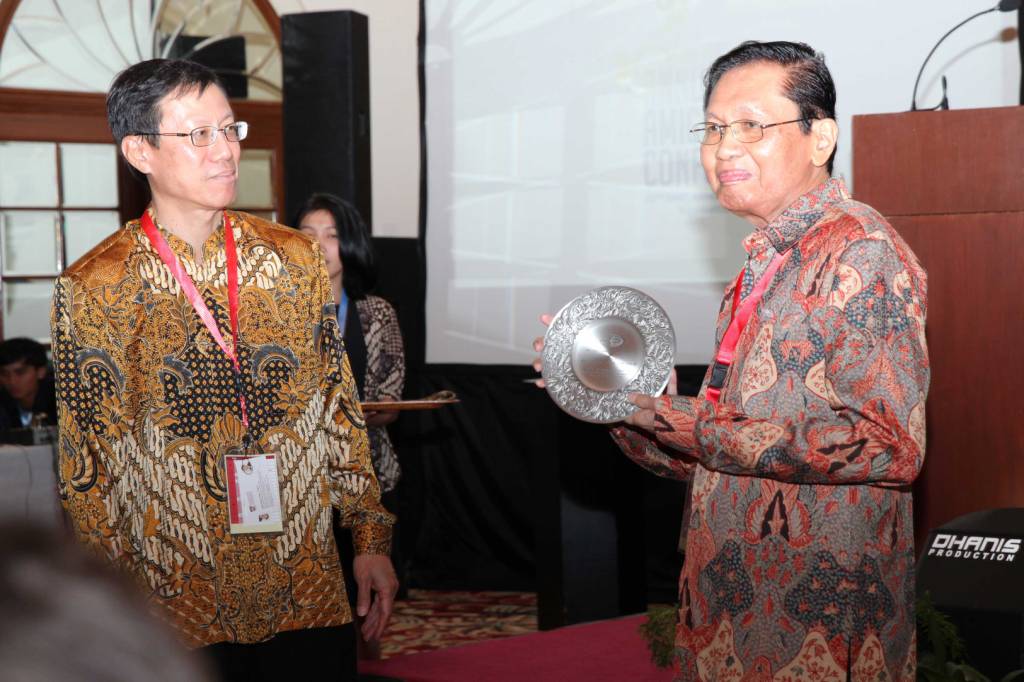
AMIC’s most prestigious annual recognition of excellence in media and communication has been made at a glittering gala dinner during AMIC’s 22nd international conference in Yogyakarta.
The AMIC Asia Communication Award is bestowed upon a person for current or past efforts in the field. It is decided by a Jury of AMIC Board members. This year, the Award was conferred on two winners.
 Emeritus Professor M. Alwi Dahlan, Emeritus Professor in Communication at the University of Indonesia, Jakarta, received the Award for “his outstanding contribution to communication research and education in Indonesia and internationally”.
 The second awardee, Mr. Jakob Oetama, President and CEO of Kompas Gramedia, one of Indonesia’s largest media conglomerates, was conferred the Award for “his outstanding contribution to excellence in print journalism and media development in Indonesia”.
Both Awardees received their plaques from AMIC’s Chairman, Professor Ang Peng Hwa. As Mr. Jakob Oetama is in ill health, his award was accepted on his behalf by Mr. Ninok Leksono, Senior Editor of Kompas.
Previous winners of the award were:
 Dr. John Lent, 2006
Prof. Eddie C. Y. Kuo, 2007
Dr. Nora Quebral and Dr. Florangel Braid, 2008
Dr. Binod Agrawal and Dr. K. E. Eapen, 2009
Dr. Hidetoshi Kato, 2010
Dr. Georgette Wang & Dr. Crispin Maslog, 2011
Tan Sri Dato’ L. Krishnan, 2012
Sep 12, 2013 | News
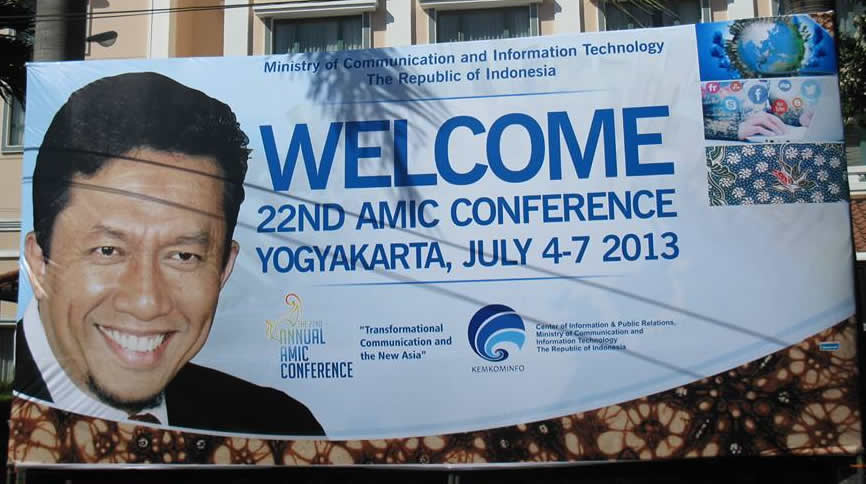
Indonesians are some of the most dynamic Internet users in the world.
 That was the message from Dr. Freddy H. Tulong, Director-General for Information and Public Communication of the Ministry of Communication and Information Technology, speaking at the opening session of AMIC’s 22nd international conference in Yogyakarta.
Of Indonesia’s population of 250 million people, some 63 million are using the Internet, with 95% of them having social media accounts, such as Facebook and Twitter.
Dr. Tulung told the audience that Indonesians are the fourth largest group of Facebook users in the world, after the USA, Brazil and India. More than 29 million Indonesians also have Twitter accounts, making them the fifth biggest global Twitter community, after the USA, Brazil, Japan and the UK. There are now more than 280 million cell phones in use in Indonesia, of which 63% are ‘smart phones’.
 Dr. Tulung was speaking on behalf of the Minister of Communications and Information Technology, Mr. Tifatul Sembiring.
The second keynote was given by Mr. Roy Suryo Notodiprodjo, Minister of Youth and Sports. The Minister outlined the way in which Indonesia’s huge population of young people was actively involved in new technologies and how these tools were changing society.

An opening address of welcome at the inaugural session was given by the Rector of Universitas Gadjah Mada, Dr. Pratikno. UGM is the host organisation for AMIC’s annual conference. The Chair of AMIC’s Board, Professor Ang Peng Hwa, and Secretary-General, Associate Professor Martin Hadlow also spoke.
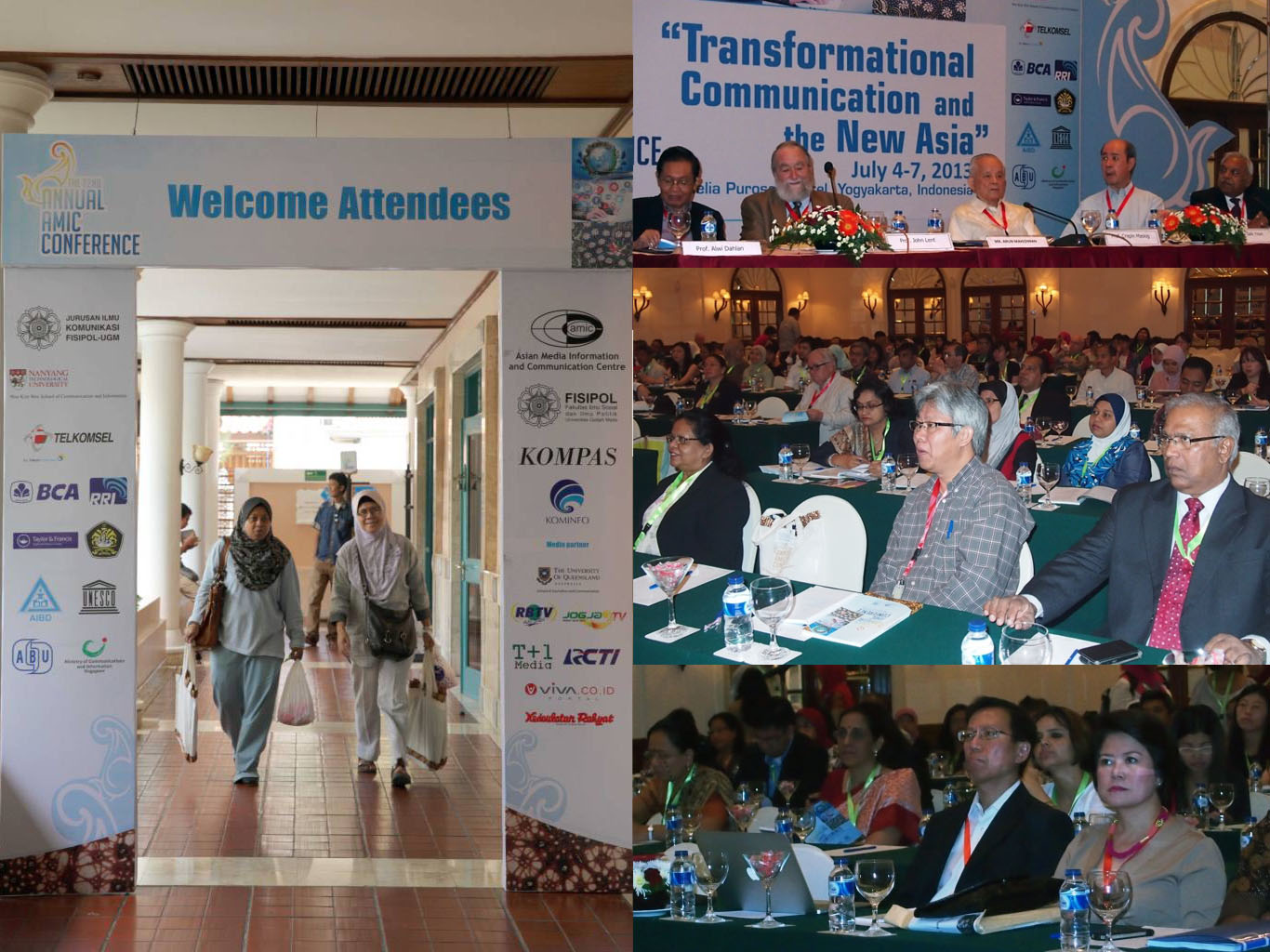
The conference, which has attracted paper presenters from 24 countries, runs from 4th-7th July.
Sep 12, 2013 | News
“Much room remains for the future of development communication in Asia” is the view of Professor John Lent, speaker in the UNESCO Emeritus Dialogue at AMIC’s 2013 international conference.
 A veteran specialist in the field of Asian development communication, Professor Lent, of Temple University, USA, said that poverty in Asia had not dropped as much as had been hoped and that most of the world’s chronically malnourished live in the Asia-Pacific region. He said that small communication projects initiated by communities to address poverty issues at the grassroots level are still important.
The UNESCO Emeritus Dialogue was held as the first plenary session at the AMIC 2013 conference in Yogyakarta, Indonesia (4th-7th July). The topic for discussion was Development Communication and the New Asia: still a role?
Another speaker, Chin Saik Yoon, Southbound Press publisher from Malaysia, asked about the role of development communication 50 years hence. “What will be the ‘new poverty’ for Asia in 2052?” he asked.
According to Mr. Chin, the main future issues relate to climate change and sustainable development. He talked of consumption patterns and contended that “we may have to admit our messages in the past were wrong.” Given the long-term implications of climate change, Mr. Chin said that “solutions may take two or three generations to complete”. In the future, there will be no more “personal gain” messages he believes. He offered the view that messages will have to play on altruism and that people will have to accept that “you do this so your great-grandchildren will still have water to drink.”
Long-term Philippines development communication expert, Professor Crispin Maslog, reinforced the view that “development communication still has a place in the world while there is poverty”. Similar views were held by other UNESCO Emeritus Dialogue speakers, Professor Alwi Dahlan from Indonesia, and Professor Binod Agrawal from India.
In a world of new technologies where poverty is still widespread, “we have to recapture our humanity” Professor John Lent reminded the audience.

Sep 12, 2013 | Annual Conference, News
 In a video presentation for the UNESCO Emeritus Dialogue session on development communication, UNESCO’s global Director for Freedom of Expression and Media Development, Guy Berger, has said that AMIC is “one of the most esteemed research partners of UNESCO”.
He talked of “new paradigms in development communication” and said that “since the early behaviourists’ concepts and practices of ‘devcom’, there has been dynamic and, indeed, pluralistic development of paradigms in this field.” Dr. Berger said that “these reflect the changing contexts nationally, internationally and technologically”.
The AMIC conference UNESCO Emeritus Dialogue brought together five international experts to look at whether development communication still has a place in the ‘New Asia’.
Aug 23, 2013 | Media Asia
|

|
Subscription
Individual: US$95 / SG$120.00
Subscribe
Institutional: US$200 / SG$250.00
Subscribe
|
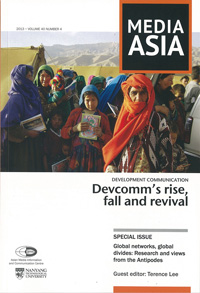
Media Asia is a quarterly magazine which serves as an important platform for the exchange of views and information on mass communication in the countries of the Asia-Pacific region. Each issue of the journal has valuable information, views and comments relevant to communication professionals, scholars and laymen.
Editorial
Welcome to the new Media Asia. Since 1974, Media Asia has helped to fulfil AMIC’s mission of nurturing and promoting research and dialogue on media and communication in the region. Entering our fortieth year, Media Asia remains focussed on this role. But, starting with this issue, we will be approaching it in a whole new way.
The most obvious change is in our physical format. We’ve abandoned our old A4 size for this new compact package. Our new dimensions mirror AMIC’s other journal, the Asian Journal of Communication, to emphasise the complementary roles that we play.
It is between the covers that you’ll find the most significant changes. The core of this journal will remain: In each issue, we will still publish several original scholarly research articles blind-refereed by experts in the field. Media Asia’s Research section leans towards empirical studies with a fairly direct impact on practical challenges in Asian media and communication. In line with this continuity, Sundeep Muppidi remains in charge of our research section.
In addition, the new Media Asia contains substantial new sections highlighting current ideas, trends and concerns. Each issue starts with in-depth, journalistic reportage, a feature article analysing a major topic of contemporary interest. In our insights pages, authoritative thinkers and leading practitioners share their opinions on key issues. There is also a section highlighting noteworthy works. Here, we’ll review not only books but also relevant online reports, documentary films and other resources that merit your attention.
We are also excited about our new casefile section. Despite the huge growth of Asian media and communication activities and education, there is a crying need for well-written, easily accessible Asian case studies to use in teaching and research. Media Asia will do its part to help fill the gap.
All thesechanges are guided by our assessment of the strengths and limitations of conventional academic journals. Most journals are dedicated to showcasing the fruits of scholarly work, in the form of peer-reviewed research articles. But, this is only one part of the life cycle of scholarly inquiry. Before new findings are ready for harvesting, the soil has to be tilled and seeded with the right questions. And, after research is published, we need to take stock of how new knowledge is being used on the ground.
We’d like to think of the new Media Asia as contributing to this wider ecosystem. We aim to serve readers who want to harness reliable research and credible, critical insights in order to address contemporary media and communication challenges in Asia. We want to connect researchers, educators, students, practitioners and policymakers, by publishing not only the new findings contained in research articles, but also signposting new directions for research and flagging pertinent questions.
Of course, we will be only as good as the contributions we receive. Please consider Media Asia as an outlet for your research, following the submission guidelines on page 96. If you are interested in contributing to our other sections – Insights, Casefile and Noteworthy – please refer to www.mediaasia.info for more details.
Thank you.
Cherian George
Chief Editor, Media Asia
