Important Dates
AMIC CONFERENCE COUNTDOWN
Day(s)
:
Hour(s)
:
Minute(s)
:
Second(s)

Day(s)
:
Hour(s)
:
Minute(s)
:
Second(s)
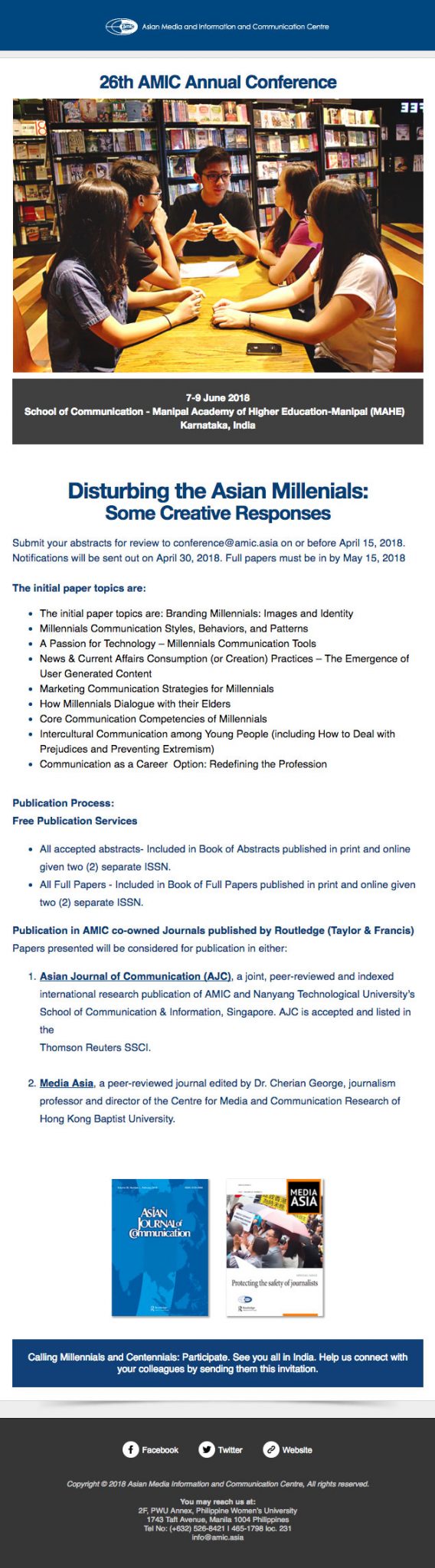

Understanding the Asia Pacific Millennials
Millennials, the 16‐34 year‐olds, make up the majority of the total population of many Asia Pacific countries. It is estimated that there are about 606 million millennials in the Asia‐Pacific region.
While millennials make up a homogenous group in terms of age cluster, they can be categorized as either non‐affluent or affluent with the latter outnumbering as they account for 82 percent of all millennials in the region.[1]
Another reality is that these millennials are located in a geographically and culturally diverse setting.
Current and emerging socioeconomic and political realities are “disturbing” the millennials just as they have the capacity to disturb society.
Globalization, migration, and technology are some of the major factors that are redefining millennials way of life. They are digital natives who do not only “consume” media but prefer creating their own content. Technology (read: smart mobiles) is not a tool but the air they breathe. Social networking is an essential prerequisite to be connected. A major fear is to be a FOLO – Fear of Life Offline. Erstwhile, fear was to be a FOMO – Fear of Missing Out.
Preserving the status quo or being a mere passive spectator is out of the question as their lifestyle and work style is ruled by engagement, creativity, innovation, and change.
Millennials are into multitasking for several reasons but primarily to earn as much from as many revenue sources to be able to purchase their wants (and needs). Multitasking is also a means for creative expression –which they have plenty. From multitasking, they are now evolving into being multi‐hyphenate, e.g., a young professional writer, artist, and entrepreneur rolled into one.
How do millennials disturb society? Their being independent (if not self‐absorbed or “me culture”) makes them in‐charge of their future. They demand new careers (or even create their own) as they find many existing disciplines and professions as very traditional. The competencies earned in school are mere inputs to redesigning new careers. The school is just one of the many learning hubs.
Disturbing does not refer only to a negative disruption but also to a movement needed to rebuild a broken or unsettled society. We must disrupt in order to rebuild!
Are we disturbing our millennials giving them the environment conducive to change? Or are we just distracting them from releasing their energy?
We are “distracting” our millennials if we insist on enforcing inflexible rules, offering traditional (read: archaic) programs, setting or measuring standards and practices based on obsolete measures, feeding them with alternative truths (facts), and not giving value to arts and humanities (which has found renewal among our young people).
True to form, millennials can initiate and lead if the existing systems are unable to “deliver” what are needed to rebuild a society they envision.
Disturbing Asian Millennials: Some Creative Responses will examine the disruptions affecting our millennials and how these young people are creatively responding to or coping with disruptive changes and challenges. The conference will also crowdsource from them ideas and strategies in creating and building an alternative or desired Asian community.
Forum Objectives
The forum provides a platform to achieve the following:
Conference Style and Approach
AMIC 26th Annual Conference is envisioned to be for and by Asian millennials.
The conference may begin by featuring millennial “triggers” who will describe and examine ongoing disruptions and their impact on young people and society in general. The triggers are also expected to raise questions (and issues) which require reflection during and after the forum. The triggers will also discuss an ideal advanced communication education that will empower the young people to pursue a career of their choice (and design).
The triggers will be followed by the innovators, millennials who have shown exemplary practices as communication entrepreneurs or professionals. These innovators will also outline the competencies gained inside (and outside) the classroom and how these competencies enable them to succeed, if not excel. They may react to the insights shared by the triggers and present their own recommendations on how to succeed in chosen career(s) and define an ideal advanced communication program.
Plenary Session Themes (as of 30 April 2018)
Under Parallel Session Topics (as of 30 April 2018)
[1] https://asia‐research.net/reaching‐asias‐affluent‐millennials/
Shelton A. Gunaratne professor emeritus, MSUM
During my recent (end of September) visit to the Philippines, I spent a whole day—a Friday—with five Asian communication scholars led by Crispin Maslog, (Philippines) the chairman of the board of directors of AMIC (Asian Media and Communication Center), on a tour of traffic-congested and polluted Greater Manila. Our team included John Lent (United States), Peixin Cao (China), Professor Zulu (Indonesia), me, and my spouse.
Maslog informed us that considering our departure schedules the next day, he would take us to a few selected spots that might be of professional interest to us mostly in and around the old city of Intramuros, which eventually was absorbed into the sprawling megapolis of Manila. Because of the unruly traffic mess in Metro Manila, even the hardiest traveler cannot hope to explore more than a fistful of the city’s tourist attractions in one day.
Maslog’s plan included stops at the University of Santo Tomas (UST) in Sampaloc, the Manila Bulletin building in Intramuros, lunch at the Bayleaf Hotel and Restaurant overlooking the walls of the old city of Manila known as Intramuros, the AMIC headquarters at the Philippine Women’s University, and the Philippine International Convention Center. Our leisurely tour of these few places took the entire day.
Starting from our hotel in Mandaluyong City (part of metro Manila) mid-morning, our experienced driver cut through the traffic mess and brought us to the UST campus in Sampaloc, the oldest university of the Philippines, and of the whole of Asia, with a current student enrolment of about 43,000. It is a private nonprofit Roman Catholic research university established in 1611. It currently holds the fifth rank in academic standing among the 67 universities, colleges and other mostly private, higher education institutes in the National Capital Territory (Greater Manila) alone. (The top four are the University of the Philippines at Diliman, Ateneo de Manila University, De La Salle University, and the U of P System.) I wondered whether Sri Lanka would ever allow the proliferation of such a variety of higher-ed institutions considering the recent fuss over SAITM.
The purpose of our visit to UST was to confer with Jose Arsenio Salandanan, chairman of the department of communication and media studies in the faculty of arts and letters, and a few graduate students about how the department has de-Westernized communication theory to be more in tune with a resurgent Asia. The university supplied Subway sandwiches for the participants to munch for lunch if they felt any hunger pangs.
Maslog, now 87, told us that UST was his alma mater in the 1950s. After graduation, he proceeded to America, where he attended the school of journalism and mass communication at the University of Minnesota to get his MA in 1962 and PhD in 1967. Back in the Philippines, he served as the director of the school of journalism at Silliman University in Dumaguete City and as a columnist for the Philippines Inquirer, a national daily. Then, in 1982, he moved to the University of the Philippines at Los Banos as a professor. He has edited or authored 35 books so far, including two released in 2017: Martial Law Joke Atbp, and Deconstruct to Understand: Why President Duterte Speaks His Way.
Maslog seemed overwhelmed by nostalgic memories of his undergraduate days at UST that our visiting team must also sense and feel. He celebrated his pride of these memories by showing us the glorious past of his alma mater at the next stop of our tour: the old city of Intramuros (meaning ‘walled city’) founded by the Spanish invaders who conquered the archipelago in the 16th century and made it the capital of the Philippines in 1571. The UST began its life in 1611 as Colegio de Nuestra Señora del Santisimo Rosario in Intramuros, about 5km southwest of its present location in Sampaloc.
The Spanish colonial government erected Intramuros with a moat around it on the ruins of a Malay settlement at the mouth of the Pasig River. The wall was for protection against foreign invasions; and for 400 years, Intramuros became the center of Spanish political, religious, and military power in the region. But it was nearly destroyed by the Japanese and the Americans during World War II. The government restored it as a tourist attraction in the 1980s.
We learnt that the Philippines’ second oldest daily newspaper, The Manila Bulletin, had its beginnings in Intramuros in 1900 with Carson Taylor, an American, as its founding editor and publisher. We visited the spot as an obligatory media professional duty and enjoyed sipping a cup of Starbuck coffee that we bought from the commercial coffee lounge located on the ground floor of the two-storey Bulletin building on Recolletos Street.
Next, we went to the nearby Bayleaf Intramuros, a hotel and restaurant at the Muralla corner, Victoria Street, for a sumptuous lunch while relaxing in the restaurant’s sky deck, which offered an uninterrupted 360-degree view of the entire Manila Bay skyline. Although we did not have the time to join a walking tour of its restored historic icons—Fort Santiago, Manila Cathedral, San Ignacio ruins, San Augustin Cathedral and Monastery, Barrio San Luis, etc.– we had a bird’s eye view of the entire complex, including Rizal Park, also known as Luneta, from the sky deck.
While I was relishing my Filipino lunch with my Asian colleagues, I could not help but recall with pleasure the encounters I had with a few other walled cities in the world: Chester by the River Dee in northwestern England, Leeds in West Yorkshire, and Xi’an in China. Although each had
Its own charm and unique attributes, Xi’an offered the best value for money as one of the world’s largest city walls. It was the eastern terminus of the Silk Road and home to the Terracotta Army.
We left Intramuros about mid-afternoon and headed for 1743 Taft Street to visit the AMIC head office now housed in the Philippine Women’s University (PWU), about 4 km southeast of Bayleaf.
One member of our group, John A. Lent, a prolific author of communication-related books, had arranged with Maslog to donate to the AMIC archives four of his (Lent’s) books, as well as communication artifacts and research notes he collected to write the book titled ‘Philippine Mass Communication: Before 1911 and After1966.’ The donation also included Lent’s typed and handwritten abstracts of 627 book and magazine articles he compiled in 1964-65.
Lent was interested in Southeast Asia as a young American researcher, and he lived in the Philippines and Malaysia for considerable periods of time in the ‘60s and the ‘70s. He was a pioneer in initiating the journalism and communication program at Universiti Sains Malaysia (USM). After I got my doctorate in 1972, it was Lent who was instrumental in getting my lectureship at USM in Penang. I also wrote the chapters on Sri Lanka for two of the books he edited: ‘Broadcasting in Asia and the Pacific’ (1978) and ‘Newspapers in Asia’ (1982). After he retired from his professorship at Temple University, he has devoted full-time attention to editing and publishing the International Journal of Comic Art, which he started in 1999.
Obviously, Lent wants Asian researchers to look deeper into his contribution to Asian mass media education. Maslog wanted our tour group to witness the hand-over at a makeshift ceremony attended by AMIC staff and three officials of the PWU: Arts and Sciences Dean Olivia Celeste Villafuerte; Media Director Lyca Benitez-Brown; and Academic Affairs SVP Felina Young. This event took about two hours.
This left us to decide whether we should visit the Philippine International Convention Center (PICC) in Pasay City further to the south, considering the sunset had begun. It was President Marcos who got the Brutalist- style PICC built in two years by presidential decree (starting in 1974, and inaugurating it in 1976). It became the venue for Miss Universe 1994.
Maslog kept to the original itinerary of ending the tour at PICC just to show us the scenic bay area along the coast. The darkness of the evening discouraged us from even getting off our tour vehicle when we reached the venue.
We returned to our hotel to get ready for the next day (Saturday) departure.
Source: (LankaWeb – 28/01/18) http://www.lankaweb.com/news/items/2018/01/27/a-days-tour-in-manila/
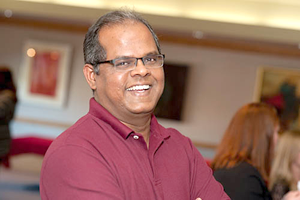
 Former AMIC Secretary General Sundeep Muppidi, PhD, was named one of 46 American Council on Education (ACE) fellows for the 2017–18 academic year. Muppidi, who has been a faculty member at the University of Hartford since 1998 and associate dean for the past two years, was nominated for the fellowship by University President Walter Harrison.