AJC: Call for Papers

CFP: AI for Governance in Asia: Power, Politics, and Ethics

Co-edited by: A/P Jian Xu (Deakin University, Australia)
Prof Terence Lee (University of Nottingham, Ningbo, China)
Prof Gerard Goggin (Western Sydney University, Australia)

In recent years, AI governance has emerged as a critical – and inescapable – topic in digital media and communication studies, amid a global ‘race to AI regulation’ (Smuha, 2021). Scholars have examined the frameworks, policies, institutions, and practices that shape how AI is developed, deployed, and regulated worldwide. Xu, Lee, and Goggin (2024) had taken the lead in this topic when they co-edited the first special issue on AI governance in Asia – in Communication Research and Practice journal (Volume 10, Issue 3) – which offered significant insights into the regulation, governance, and geopolitics of AI in the region and beyond.

For this proposed special issue with the Asian Journal of Communication, we invite a shift in perspective from ‘AI governance’ (governance of AI) to ‘AI for governance’ (governance by AI) — examining how AI itself is used as a tool for governance. This approach does not render AI governance research obsolete; rather, it complements and enriches it by critically exploring how states, institutions, and organisations deploy AI to achieve governance goals, such as policy administration, service delivery, social welfare, security, policing, surveillance, smart city, propaganda, digital diplomacy, and automated decision-making.

Essentially, we seek to understand who designs and deploys AI, for what purposes, by what means, and with what consequences; and to critically interrogate how AI reproduces power, inequality, and ideology, and to develop more ethical and sustainable regulatory strategies.

AI is increasingly applied for governance worldwide. For example, Albania recently appointed an AI bot as a ‘minister’ to tackle corruption. In Asia, Hangzhou, China launched City Brain 3.0 in March 2025, integrating AI technologies into urban governance. In India, political parties harnessed AI during the 2024 general elections, while in Singapore and South Korea, AI supports predictive models for disease outbreaks and other public health measures. Asia is particularly compelling for studying ‘AI for governance’ due to its diverse political systems, rapid AI adoption, varying AI readiness, close state–tech partnerships, and large populations with differing attitudes toward privacy and surveillance. Studying Asia offers unique insights into the power, politics, and ethics of AI-empowered governance.

We welcome submissions offering critical, social, political, and cultural analyses of ‘AI for governance’ in Asian societies. Contributions are expected to examine how AI is employed to exercise power, manage populations, and shape social order, as well as to address the questions of accountability, transparency, fairness, ethics, and democracy that arise in the process of ‘governance by AI’.

We hope the contextualised Asian case studies will help shed light on the power relations and dynamics among governments, tech companies, digital platforms, social organisations, families, and individuals involved in AI-enabled governance. We are particularly interested in topics that investigate the Asian contexts (e.g. Southeast Asia), and their minority and marginalised populations (e.g. migrants, refugees, children, and the elderly), which have often been overlooked in existing critical AI literature.

Possible topics may include (but are not limited to):

AI and public administration/management;
AI and service delivery (e.g. healthcare, aged care, social welfare);
AI, policing, surveillance and security;
AI and automated decision-making;
AI, smart city and urban management;
AI and propaganda;
AI and international communication;
AI and the Sustainable Development Goals (SDGs);
AI and labour governance;
Bias, discrimination and exclusion in AI-enabled governance;
Ethical dilemmas and social inequalities in AI for governance;
Platforms and AI for governance;
State-tech relations in AI-enabled governance;
Resistance and activism in response to AI for governance;
Technological determinism in the age of AI;
AI for governance and its disciplinary effects on individuals

Timeline for publication:

Abstract submission: January 19, 2026
Notice of acceptance: February 9, 2026
Invited full paper submission to the journal for peer review: July 31, 2026
Special issue publication: Mid-2027

Interested authors are invited to submit an abstract of 300-500 words, including the paper title, central argument, and methodology. A short author biography should also be provided. Please send both the abstract and author biography to the special issue editors by January 19, 2026:

Jian Xu: j.xu@deakin.edu.au
Terence Lee: terence.lee@nottingham.edu.cn
Gerard Goggin: g.goggin@westernsydney.edu.au
Call for Papers – ‘Living with Digital Platforms in Asia-Pacific: Everyday Life, Participation, Policy, and Rights’

Call for papers (abstracts due 7 February 2020)
‘Living with Digital Platforms in Asia-Pacific: Everyday Life, Participation, Policy, and Rights’
Special issue of Asian Journal of Communication

Edited by:
Gerard Goggin (Nanyang Technological University, Singapore)
Titik Rahayu (Universitas Airlangga, Surabaya, Indonesia)


Internationally, the rise of digital platforms is a highly visible phenomenon in contemporary media and communications and social life. This special issue puts the spotlight on the prefiguring, incubation, and emergence of, and contests over, digital platforms in the Asia Pacific region.

It aims to bring together research, perspectives, proposals, provocations, and debate on questions such as:


  • What are the business models, economics, and service offerings of digital platforms in the Asia-Pacific region?
  • What are the socio-political and economic challenges for startups in developing countries to develop new digital platforms and compete with established multinational corporations?
  • How do digital platforms circulate and operate across and within the Asia and Pacific regions? What are the connections between digital platforms in Asia and other regions, as well as global digital platforms?
  • How do digital platforms figure in ­everyday life in Asian and Pacific settings, and what are their socio-cultural dynamics and implications?
  • What are the social imaginaries of Asian and Pacific digital platforms?
  • What theories and concepts are elicited by, and are suitable for, researching Asian and Pacific digital platforms?
  • What is the state of play for digital platforms in relation to social, political, cultural, and other forms of participation?
  • What are the policy issues being raised by digital platforms in Asian and Pacific contexts, and how are policymakers and regulators responding?
  • Where do digital platforms fit into questions of inequality and social justice?
  • What of the implications of digital platforms for communication and expression rights, as well as other human, social, and cultural rights?
  • What are the alternatives to digital platforms being generated or debated in Asian and Pacific societies?


We welcome papers on these and other relevant aspects of digital platforms in Asia and Pacific. We are especially interested in research that addresses neglected or new case studies and dimensions of Asian digital platforms. Also we encourage papers that reflect upon and comment upon the research, practice, policy, and other agenda on digital platforms in Asia-Pacific contexts.

Please send a 300-500 word abstract for consideration by 7 February 2020 to the special issue editors:

Gerard Goggin, Nanyang Technological University (gerard.goggin@ntu.edu.sg);
Titik Rahayu, Universitas Airlangga (titik.rahayu@fisip.unair.ac.id)

Following notification of acceptance of abstract, full papers of 6000-9000 words will be due by 15 July 2020 (with full submissions due by 15 December 2020).

For more information on the Asian Journal of Communication, and its style requirements, see https://www.tandfonline.com/toc/rajc20/current.

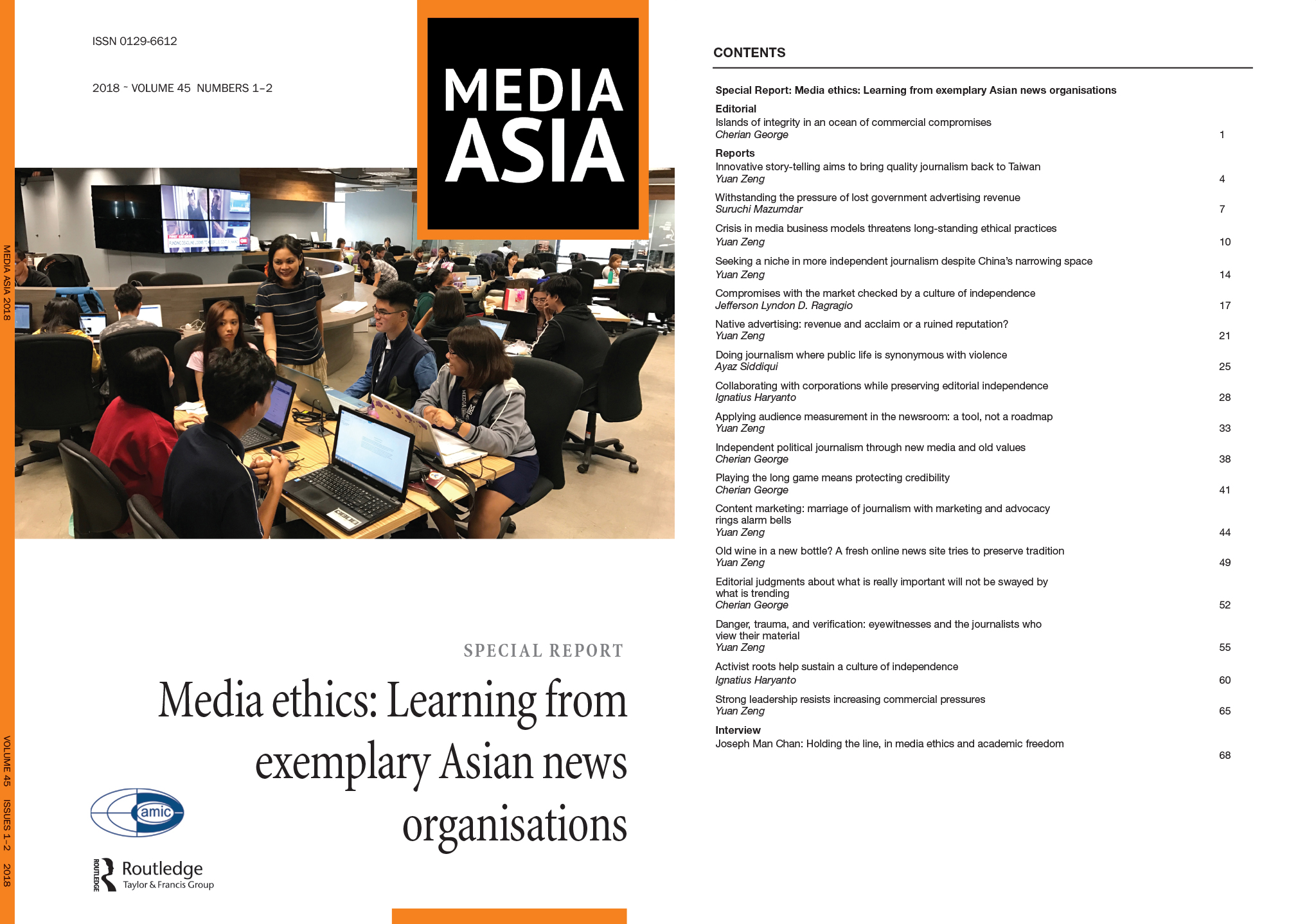
AJC and Media Asia 2016 issues out

AJC and Media Asia 2016 issues out

Four 2016 issues of Asian Journal of Communication (AJC) and one Media Asia issue are already out.

AJC Vol. 26, No. 4 (August 2016) contains articles probing communication styles in different areas of the world, such as comparing the presidential rhetoric of South Korea President Lee and US President Barack Obama.

Theoretical articles are presented, such as probing moderating role of cultural orientation in explaining temporal orientation of self-referencing, and examining a new contextual perspective for crisis communication theory comparing the Eastern and Western traditions.

Communication issues that have arisen in specific countries are also probed, such as an examination of Chinese media’s implicit and explicit agendas; changes of cultural representation in Indonesia’s children’s television from 1980s-2000s; and examining the impact of message framing and temporal distance related to the communication to young Chinese of the human papilloma virus.

The AJC August 2016 issue also contains a book review of Making news in India: Star news and Star Ananda, written by SomnathBatabyal and published by Routledge.

Meanwhile, Media Asia Vol. 43, No. 1discusses the national anniversaries of Philippines and Indonesia as “narratives of remembrance”, with an interview of Dr. Crispin C. Maslog, AMIC Board of Directors chairperson, remembering the People Power Revolution. It contains two articles on what happened in Indonesia in 1965 when the Sukarno government was overthrown.

Articles also include a discussion of Japan press clubs, a Chinese dating show, television in India, reporting on the Malaysian Airline MH370 tragedy, border radio in Thailand and Malaysia, Indian Media Organization, and social media influencers in Singapore.