
Oct 3, 2014 | Member Updates, News
Dear AMIC members and friends,
Greetings!
I’m writing to share with you some important developments with regard to AMIC.
AMIC was founded in 1971 and has always been based in Singapore. Since 1996, the Nanyang Technological University (NTU) has been our headquarters and also the single most generous financial supporter of AMIC. However, NTU now has new priorities and the high level of support it has been providing AMIC is no longer feasible from its own perspective. For us, however, the much reduced offer of support it made is not sufficient to run even the basic operations of AMIC.
Thus, your Board of Directors was compelled to look for an alternative location for the Secretariat operations of AMIC. The Board received a few proposals from interested parties to host AMIC. After much deliberation, and weighing all the pros and cons of various hosts, the Board has concluded that the proposal from a consortium of the Philippines Women’s University (PWU) and the Asian Institute of Journalism and Communication (AIJC) in Manila was the best. The proposed PWU-AIJC Consortium involves an established university and an eminent NGO. The consortium’s strengths are congruous with the key AMIC functions in research and training, as well as our publications programme.
Thus, while AMIC remains a ‘company limited by guarantee’ registered under the Accounting and Corporate Regulatory Authority, Singapore, the day to day operations of the Secretariat will move from Singapore to Manila shortly. We will ensure that the transition is as smooth as possible.

Another important development is the change of leadership at AMIC headquarters. Dr Martin Hadlow, who has been serving AMIC as Acting Secretary General for the past two years, has stepped down from his position but remains on the Board. In view of the transfer of AMIC headquarters to Manila, the Board has now appointed Mr Ramon Tuazon, current AMIC Board Member from the Philippines, as the new Acting Secretary General until a permanent appointment is made. You will be soon hearing from Ramon directly.
On behalf of the Board and all members of AMIC, I wish to record our deep gratitude to NTU, especially the Wee Kim Wee School of Communication and Information, its Chair, Prof Chuck Salmon, and its staff for their long and generous support of AMIC over the years. The association with NTU has been rewarding and fulfilling.
I also wish to record, on all our behalf, our great appreciation to Martin for stepping in to act as the Secretary General during a difficult transition. He served AMIC ably and unstintingly, and towards the end, without any remuneration. It was a remarkable gesture of his commitment to AMIC and the Board and management of AMIC are most grateful to him.
Next, I wish to warmly welcome Ramon as the new Acting Secretary General and, on all our behalf, wish him the best in his new undertaking in AMIC. We very much look forward to the new chapter opening in Manila under his leadership.
You will be pleased to know that the AMIC management has already started to work on the next Annual Conference and we hope to make a formal announcement soon.
Finally, on behalf of your Board and my personal behalf, I wish to thank each and every member of AMIC for their continued support and understanding. Without you, we would not have come this far, nor will we go much further.
Arun Mahizhnan
Chair, Board of Directors
AMIC
Jan 23, 2014 | Member Updates
Dec 10, 2013 | Annual Conference, Member Updates
Globally, the last decade has seen exponential growth in the use of mobile technologies and the Internet. From e-mail to e-governance, e-commerce to e-learning, Internet usage has changed the way the world communicates.
At the forefront of the electronic and digital revolution in Asia has been the mobile phone. Recent International Telecommunication Union (ITU) statistics indicate that in the period from 2005 to 2013, mobile (cellular) phone subscriber numbers in the Asia-Pacific region have soared from 833 million to 3,547 million users. The era of an e-Asia has dawned.
The benefits of instant, intranational and trans-border communication have impacted upon almost every aspect of life, with mobile phones and the Internet providing new pathways for inter-personal communication, business and commercial enterprise, community development, educational opportunity, governance and democratic reform. Information and communication technologies (ICTs) are an enabling factor in supporting marginalized societies to more beneficially interact with a broader citizenry, while the convergence of computers, media and telecommunications has created new platforms for entrepreneurship, education and political inclusion.
However, in the Asia-Pacific region, where cultural traditions and family values are hugely respected and deeply ingrained, the influences of a new ‘e-Asia literacy’ are impacting on social conventions, etiquette, language and community structures. In a homogenized international ‘knowledge society’ where communication processes transcend national boundaries, the retention of traditional values and ways of life are increasingly challenged.
AMIC Secretary-General, Martin Hadlow, said that next year’s AMIC international conference theme Communicating in an e-Asia: values, technologies and challenges recognised the huge changes now in progress in the Asian communication landscape.
“At last year’s Yogyakarta conference, we heard of the astonishing growth of new media technologies and the huge numbers of Indonesians now accessing the Internet” he said. “At next year’s conference, to be held in Bangkok, we look again at the field from a scholarly perspective. Our range of conference streams should satisfy all scholars with an interest in communication in Asia and the Pacific”.
Please download the call for papers by clicking here.
Sep 25, 2013 | News
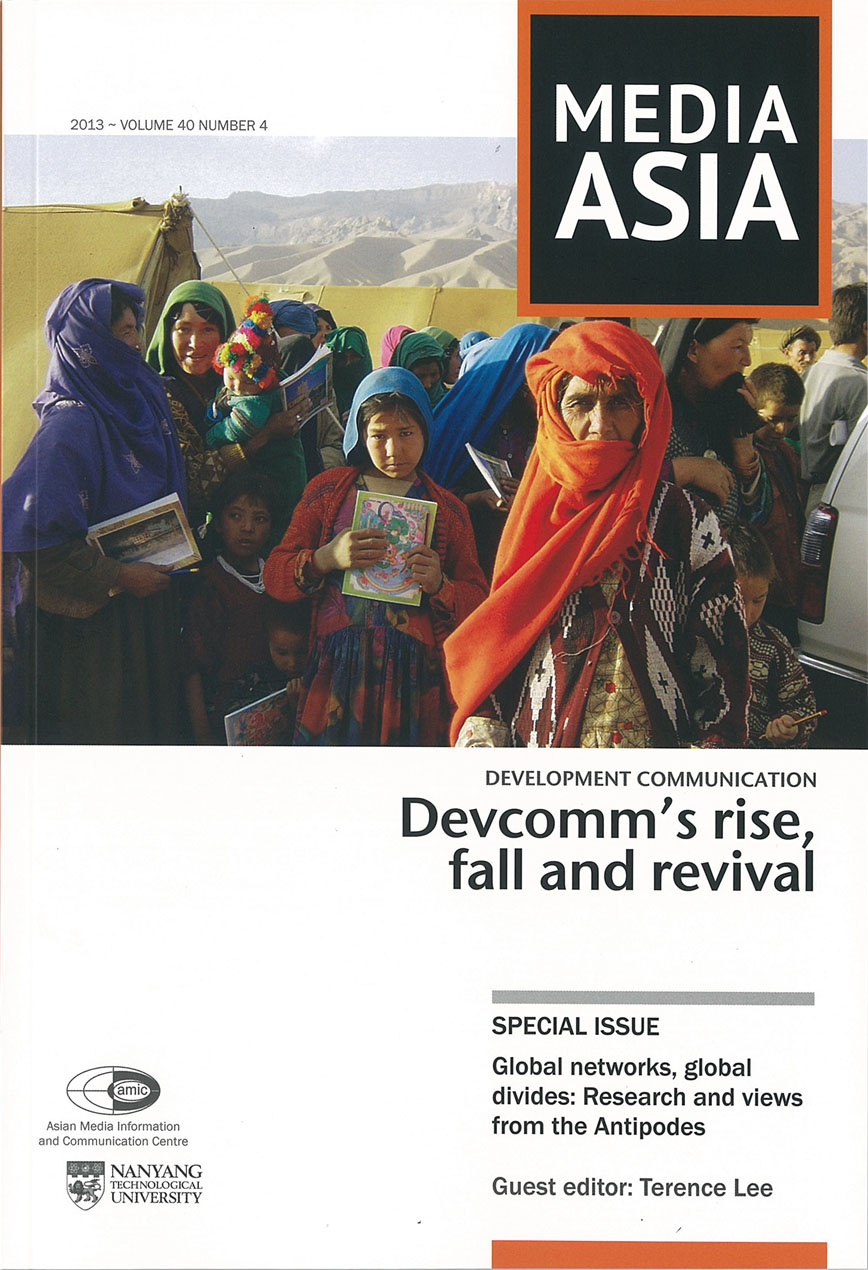
 Is the discipline of development communication a spent force or one on the ascendancy? That’s the subject of a keynote article in the latest issue of AMIC’s quality quarterly publication, Media Asia. In The rise, fall and revival of development communication, Associate Editor, Rachel Khan, plots the course of the subject since the Lerner, Schramm and Rogers days of the 1950s and 1960s. Drawing on a variety of sources, including the proceedings of the UNESCO Emeritus Dialogue session on development communication at this year’s AMIC annual conference in Yogyakarta, the author traces a series of experiences from Asia and Africa.
Media Asia also features a ‘special issue’ research section headed Global networks, global divides: research and views from the Antipodes. Guest edited by AMIC’s Country Representative in Australia, Dr. Terence Lee, from Murdoch University in Perth, the section includes papers from several Australian scholars.
Professor Emeritus at Temple University and former winner of the prestigious AMIC Asia Communication Award, John Lent, is the subject of Media Asia’s highlight Interview. “I didn’t apply for grants” Lent tells interviewer Dr. Cherian George, “because I didn’t want to be beholden to anybody else.” His passion for academic independence, not to mention comic art, has made Professor Lent an entertaining conference presenter and a global leader in the field of comics. His Interview is full of wisdom and surprises.
Elsewhere, Media Asia includes an Insights article on media self-regulation and the Indian press by Singapore-based law and policy expert, Professor Ang Peng Hwa, and a case study by Dr. Usha Harris on the use of media in assessing climate change impact in the Pacific. AMIC Secretary-General, Martin Hadlow, contributes a reminiscence on media development in Afghanistan, where he was based for almost three years.
Media Asia Vol. 40, No. 4, 2013, is now available for purchasing on-line at www.amic.org.sg
Sep 25, 2013 | News
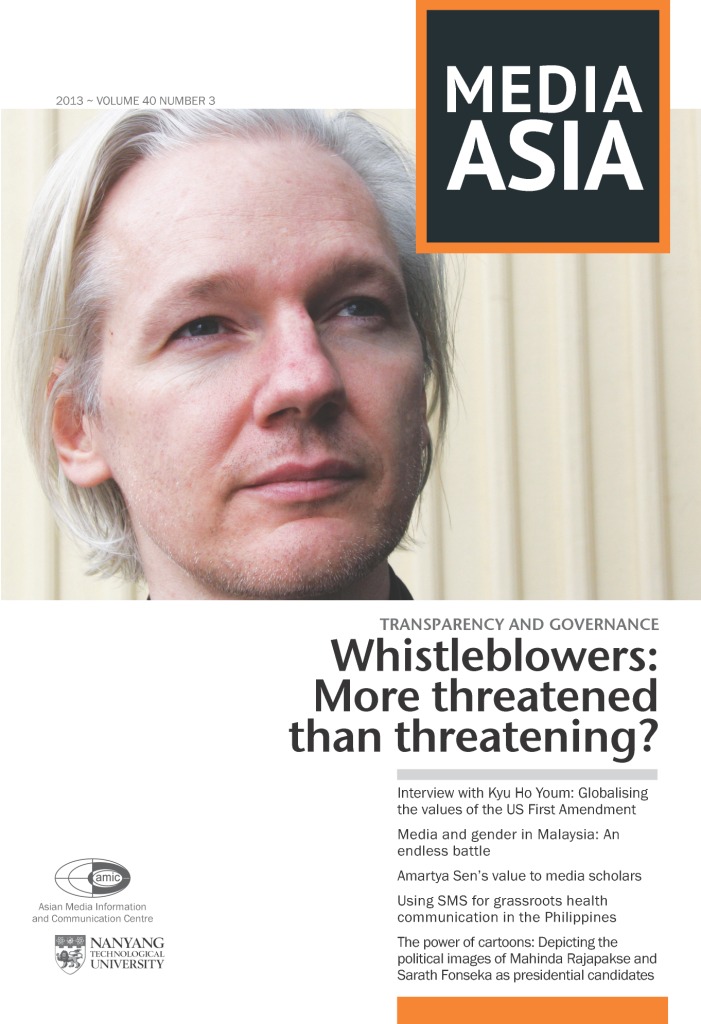
 Should whistleblowers, such as the American intelligence analyst Edward Snowden and US Army Private Bradley Manning, be treated as heroes or traitors?
The debate on Government secrecy and the public’s ‘right to know’ is given an airing in the latest edition of AMIC’s quality, quarterly journal, Media Asia. In an article on recent global controversies which have placed the spotlight on the power of individuals to expose high-level corruption and other activities, Suruchi Mazumdar examines the rationale for protecting whistleblowers and also questions Asia’s ‘patchy record’ in this field.
Also in Media Asia Volume 40, No. 3, Editor-in-Chief, Professor Cherian George, interviews Asian-American scholar Dr. Kyu Ho Youm on the influence of America’s First Amendment values and the issue of free speech in Asia. Media Asia also features insights on Media and Gender by Universiti Sains Malaysia Deputy Dean, Dr. Azwan Azmawati, while Amartya Sen’s value to media scholars is a topic explored by Professor Shakuntala Rao of the State University of New York.
Research papers included in this issue examine a wide range of mass communication fields. Among these, Dr. Theodore Fernando, of the Open University of Sri Lanka, looks at the influence of editorial cartoons on that country’s recent national elections, while Dr. Khairiah Rahman, of the Auckland University of Technology, discusses crisis communication and media reportage in light of issues surrounding a disruption to Singapore’s Mass Rapid Transit system. Japan’s nuclear accident woes are examined by Dr. Muneo Kaigo and Ms. Dragana Lazic as they take a closer look in their research paper at US press coverage of the Fukushima nuclear power plant accident.
Media Asia Vol. 40, No. 3, alsooffers readers case files on health communication, a comparative analysis on advertising in Vietnam, Laos and Cambodia, and book reviews of recent noteworthy publications. Media Asia is available for purchase on-line at www.amic.org.sg

Sep 12, 2013 | News

It’s all about content: positioning new radio in the ‘Knowledge Society’. That’s the theme for next year’s RadioAsia2014 conference in Colombo, Sri Lanka.
RadioAsia is the region’s premier annual event highlighting radio broadcasting’s unique role and its contribution to society. The Colombo conference is scheduled for 22nd-24th May, 2014.
In the ‘Knowledge Society’, where the Internet has become a key tool in disseminating informational materials, radio remains an effective, relatively low-cost platform in providing a range of content to diverse audiences. The traditional methods of delivering radio via medium-wave, shortwave and FM are changing as mobile devices and computers increasingly become integrated with the listening environment. However, while new ways of accessing radio are growing, at the end of the day the expression ‘content is king and technology is queen’ remains a truism.
More and more information is now available to people and they are making increased use of it in their daily lives as well as in their businesses. The application of multiple devices to consume content is now quite common. The Internet and mobile phone are enabling technologies that empower people to share experiences and information, while the availability of lifestyle information has made people’s lives richer. The challenge for radio in the information age is to continue to deliver content with substance, across a range of platforms in an age of convergence.
In the context of the ‘Knowledge Society’, where is radio’s future in the production and provision of content? Can innovative and creative programming techniques enable radio to continue to meet its obligations in the new environment while also catering to its traditional credo ‘to educate, inform and entertain’?
Sri Lanka, where RadioAsia2014 is to be hosted, has an illustrious history in radio broadcasting, being home to one of the oldest radio stations in Asia. Thus, it is fitting that the 10th annual forum for Asian radio broadcasters, RadioAsia2014, should be held in Colombo. It will be co-hosted with the ABU’s prestigious ABU Radio Song Festival. www.radioasia.org
