Media Asia analyzes repression and assertion in latest issue

Media Asia analyzes repression and assertion in latest issue

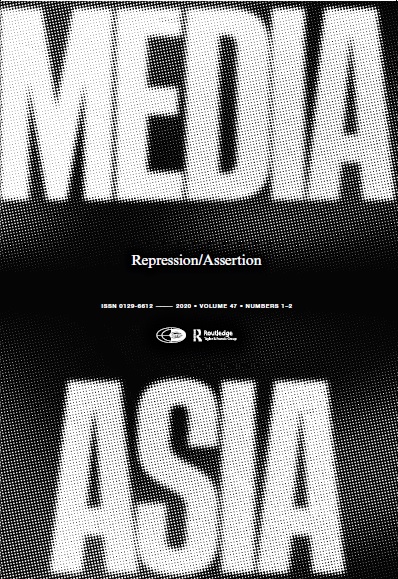
Media Asia 47 (1-2) cover

Media Asia analyzes repression and assertion in latest issue

An international peer reviewed journal bravely confronts a sensitive issue plaguing selected parts of Asia.

Published by the Asian Media Information and Communication Centre (AMIC) and Routledge Taylor & Francis Group, the Media Asia journal released Volume 47 (Numbers 1-2) with the theme “Repression/Assertion.” The online edition may be retrieved from the journal’s website (https://www.tandfonline.com/toc/rmea20/current).

The issue is composed of four refereed articles and three non-refereed commentaries that focus on the realities of repression and intricacies of assertion in Myanmar, Indonesia, Thailand, Greater China (mainland China, Hong Kong, Taiwan), Pakistan and the Philippines.

The authors of the refereed articles are Nyan Lynn (University of Kansas, USA), Deborah N. Simorangkir (Swiss German University, Indonesia), Hazrat M. Bahar (Shanghai University, China) and Mengmeng Zhao (Hang Seng University of Hong Kong).

Those who wrote the non-refereed commentaries are Muhammad Ittefaq (University of Kansas, USA), Syed Ali Hussain (Arizona State University, USA), Maryam Fatima (University of Education, Pakistan), Beatrice Puente (University of the Philippines Diliman) and Sammy Westfall (Yale University, USA).

The editorial describes the contents of the seven articles: “Nyan Lynn (The danger of words: Major challenges facing Myanmar journalists on reporting the Rohingya conflict) and Deborah Simorangkir (Work-related sexual harassment and coping techniques: the case of Indonesian female journalists) analyze the predicament of journalists in covering sensitive issues and protecting themselves from those who exploit them. Meanwhile, Hazrat Bahar (Social media and disinformation in war propaganda: How Afghan government and the Taliban use Twitter) studies how warring parties weaponize social media in spreading “fake news” and discusses why deprivation of relevant information is a form of repression. Mengmeng Zhao (How do leading companies in Greater China communicate CSR through corporate websites? A comparative study of Mainland China, Hong Kong and Taiwan) focuses on the use of corporate social responsibility and explains why corporations need to increase awareness and prevent skepticism at the same time. [xxx] Beatrice Puente (Muzzling the media: The perils of the critical press in the Philippines) and Sammy Westfall (Growth of a young journalist amid the pandemic and media repression) provide first-person accounts on the struggles of campus journalists as they are faced not just with the global pandemic but also a repressive government. Muhammad Ittefaq, Syed Ali Hussain and Maryam Fatima (COVID-19 and social-politics of medical misinformation on social media in Pakistan) present their views on how social media have been misused amid the global pandemic when accurate information is needed.”

Starting with this 2020 issue, Media Asia adopts a “new look” as designed by Karl Castro (Philippines). The cover design is inspired by the constantly evolving media landscape. Front covers are rendered in “black and white” but the nuances of each image display a much broader gamut of color, symbolizing the media’s constant struggle with truth-telling, perception, and subject position, the examinations of which are part of the raison d’être of this journal. In contrast to the black and white covers, the spines and back covers are rendered in bright fields of color. These hues are taken from both broadcast and print tests, emphasizing the spectrum of our media landscape.

The journal is indexed/abstracted in Scopus, EBSCO Research Databases (Bibliography of Asian Studies, Associates Programs Source Plus, Communication & Mass Media Complete, Communication Source, Military Transition Support Center, Vocational Studies Complete) and ProQuest (Business Premium Collection, Asian & European Business Collection, ProQuest Central, ProQuest Central Basic, ABI/INFORM Professional Advanced, SIRS Editorial, eLibrary).

Danilo Araña Arao (University of the Philippines Diliman) is the editor of Media Asia. The associate editors are Lisa Brooten (Southern Illinois University Carbondale), Pamela Custodio (University of the Philippines Los Baños), Roselyn Du (California State University Fullerton), Ma. Theresa M. Rivera (Far Eastern University Manila) and Nick Y. Zhang (Hong Kong Baptist University).

Media Asia Special Call for Papers: Media and the Pandemic

Media Asia Special Call for Papers: Media and the Pandemic

Media Asia
published by AMIC and Routledge Taylor & Francis Group

Media and the Pandemic

SPECIAL CALL FOR PAPERS

Have you recently conducted research on media and the COVID-19 pandemic in Asia? If your findings are interesting, we’re interested!

Media Asia is a peer-reviewed quarterly journal published by the Asian Media and Information Communication Centre (AMIC) and Routledge Taylor & Francis Group. Published since 1974, Media Asia is now in its 46th year.

Manuscripts should focus on relevant issues related to media’s role in relation to the pandemic. These are some of the topics that may be interesting:

  •  Impact of COVID-19 on journalism, advertising, public relations, entertainment or any aspect of media (e.g., case studies, in-depth interviews with practitioners)
  • Media coverage of the COVID-19 pandemic (e.g., content analysis, in-depth interviews with journalists)
  • Government restrictions on media coverage during lockdown (e.g., effects of government’s “virtual pressers” with screened questions from journalists, weaponization of laws against the media, state of press freedom)
  • Media technology and COVID-19 (e.g., how technology is being used to adapt to the changing environment)
  • Media operations amid COVID-19 (e.g., reduction of media workforce, limited advertising, dependence on replayed and canned entertainment programs, impact on profit, changes in routines of media practitioners, adjustments in production processes)
  • Media and the “new normal” (e.g., adjustments in the delivery of news and entertainment, quality of reportage due to limited movement of journalists and media workers)
  • Media and history of global health crises (e.g., comparison of media’s role in past health crises like SARS to contextualize COVID-19 coverage)

These are just examples of research areas and topics. Please feel free to submit other manuscripts that focus on media’s role amid the COVID-19 pandemic.

In coordination with the editor, authors may also send commentaries on media and the COVID-19 pandemic, as well as reviews of books, films, plays and other media related to past health crises. These submissions are not subjected to peer review and have faster editorial decisions.

Given the journal’s adherence to the highest degree of academic scholarship, authors should be willing to submit their manuscripts to a double-blind review process. The journal editors shall initially review the manuscript. If it is assessed to be well-written and well-researched, the manuscript (with the author’s name and other related details redacted) shall be forwarded to at least two experts on the topic who will provide objective reviews. Similar to other peer-reviewed journals, Media Asia shall only publish manuscripts from authors who are able to revise their manuscripts based on the reviewers’ comments.

Based on data from the handling of 16 manuscripts submitted to Media Asia from 1 January to 12 May 2020, our journal has a relatively fast turnaround time in terms of editorial evaluation and reviewer invitation. Authors can be assured of a hastened process of feedback even if reviewers are usually given a maximum of 30 days to submit their comments.

Manuscripts should be written in English and should have not more than 10,000 words (including tables, references, captions and endnotes). They should also have an abstract of 100 to 150 words and keywords not exceeding five. Authors should use the American Psychological Association (APA) citation style. More information about submission format may be retrieved from https://authorservices.taylorandfrancis.com/tf_quick_guide/.

Interested authors may submit online at https://www.editorialmanager.com/rmea/default.aspx.

Effective 2020, Media Asia’s editor is Danilo Arao (University of the Philippines Diliman). The associate editors are Lisa Brooten (Southern Illinois University Carbondale), Pamela Custodio (University of the Philippines Los Baños), Roselyn Du (California State University Fullerton), Ma. Theresa Rivera (Far Eastern University Manila) and Zhang Yin Nick (Hong Kong Baptist University).

If there are any questions, please send an email to media.asia@amic.asia.

Practical writing tips to get your research published in AMIC journals

Practical writing tips to get your research published in AMIC journals

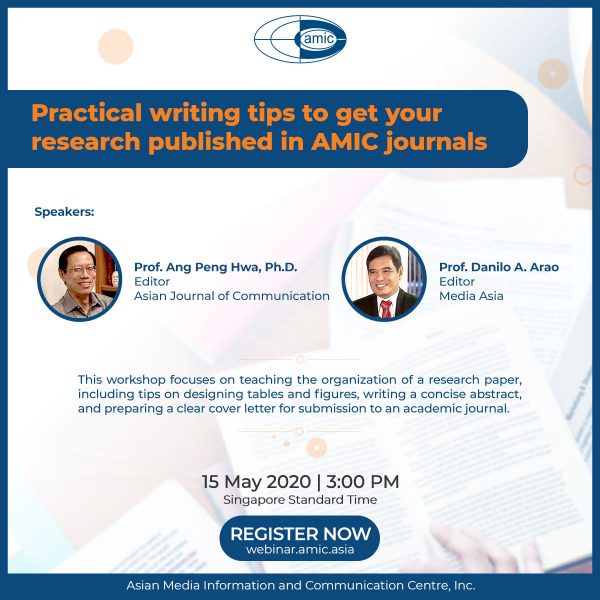
Webinar Poster: Practical writing tips to get your research published in AMIC journals

Overview

Preparing a manuscript for journal publications can be time-consuming and stressful. This 1-hour webinar prepares young and promising scholars with practical and valuable techniques when submitting a manuscript for peer-review academic journals.

Editors of AMIC Journals will share practical tips in preparing and submitting an article for journal publication. This webinar will cover organization of a research paper, but also actionable pieces of advice in designing tables and figures, writing a concise abstract, and preparing a clear cover letter for submission.

In addition, participants will learn about the publication process from a journal editor’s perspective, along with how to choose the right journal for their paper, as well as how to navigate peer review.

Join us and eliminate the guesswork in preparing to submit for journal publications.


Speakers

Dr. Ang Peng Hwa trained as a lawyer and is currently professor at the Wee Kim Wee School of Communication and Information of the Nanyang Technological University’s College of Humanities, Arts, and Social Sciences. Currently Director of the NTU’s Singapore Internet Research Centre. He was a member of the Working Group on Internet Governance that was appointed by then UN Secretary-General Kofi Annan to prepare a report for the 2005 World Summit on the Information Society. He is currently the Editor of Asian Journal of Communication.

Danilo Araña Arao is a journalist and an associate professor of the Department of Journalism at the University of the Philippines College of Mass Communication (UP CMC) in Diliman, Quezon City. He is also a faculty affiliate at the Center for International Studies (CIS) of UP Diliman and a special lecturer of journalism at the Polytechnic University of the Philippines (PUP) in Sta. Mesa, Manila. He is associate editor of Bulatlat Multimedia, an independent online publication; and editor of Media Asia, a refereed journal published by the Asian Media Information and Communication (AMIC) Centre and Routledge Taylor & Francis Group.

Webinar Replay

AMIC conducts webinar on E-teaching in Times of Crisis

AMIC conducts webinar on E-teaching in Times of Crisis

AMIC conducted its first ever webinar, E-teaching in Times of Crisis on 03 April 2020 at 1 pm SST (Singapore Standard Time). A total of 266 participants, mostly educators, from 13 countries, attended the virtual forum.

The webinar was moderated by Dr. Bradley Freeman, head of the Department of Communication of Sunway University in Malaysia. The panelists included Malissa Maria Mahmud, Senior Lecturer of Sunway University, Malaysia; Shai Reschef, President and Founder of University of the People, USA; Graham Glass, CEO & Founder of Cypher Learning and Marco Polo of De La Salle University-Dasmariñas (Philippines).

The session discussed diverse topics including managing online classes, best practices in online pedagogies, participatory and creative learning approaches, assessment methodologies and tools, and how to reach out to offline learners and teachers.

According to AMIC Secretary General Ramon R. Tuazon, the event is part of a series of activities planned in preparation for AMIC’s 50th anniversary in 2021. The next webinar is on Getting Published in Peer-reviewed and Indexed Academic Journals.

Upstream Media PH was the event’s technology partner/webinar host. A full recording of the webinar can be accessed at https://youtu.be/xQ-6kNMIgB4.